I gave my 100th training on suicide last month at Bergen County Community College to an audience of over 100 counselors, educators, advocates, leaders and law enforcement officers. That was a fairly diverse audience both demographically and professionally.
More than half of those talks were delivered to the Army, police or union workers. Not a diverse group; not really.
48,824 people died in 2024 in the United States by suicide. That number has increased steadily, with some fluctuations, since 2000 and has outpaced the increase in population over that time. Men kill themselves at about four times more than women. Whites take their lives at a much higher rate than Blacks, Asians, Hispanics and people of mixed race.1 Whenever I show the chart on race, I state that it is one of the only public health statistics I know is to where minorities have better outcomes than Whites2. Of working age adults, people aged 45-54, solidly in middle age, die by suicide at the highest rate. They are sandwiched by the next highest groups on either end of them, 55-64 and 35-44.3
To review, the data tells us that the group that kills themselves the most are white, middle-aged men. When I look at an audience of soldiers, cops or union workers, I ask, “Sound like anyone you know?”
According to a CDC study that I have used for years,4 the most common specific life stressor for someone who dies by suicide is a romantic relationship problem. After that, the other most common crises include mental health concerns, substance misuse, financial problems and occupational distress. This tracks exactly with my clinical work over the last ten years.
I suspect that almost everyone reading this will agree that romance, mental health issues, finance, job problems and alcohol misuse are familiar to us or those around us. And yet, despite those common stressors, most people don’t think about, attempt or actually take their own lives.
Access to firearms is a huge risk factor. In 2024, there were 48,824 deaths by suicide in the United States. Of those, 27,593 were by a self-inflicted gunshot. That means that 56% of suicides in the United States in 2024 were from firearms.
I’ve been using an incredible chart published by the New York Times in 2017 for my speeches and classes when talking about suicide. Last month, someone asked me why I haven’t updated it. I told him that I hadn’t seen a new chart like that, but that it wasn’t an excuse. I pulled the latest numbers off of the SPRC website and had ChatGPT put this new graphic together.
Mass shootings are horrifying. The sheer number of incidents provokes anxiety and outrage. Any of us in the United States could seemingly die in the next mass shooting. And yet, it only accounts for 1.1% of firearm deaths. The professional media, social media and the charlatans that occupy the strange, online outrage space all spend way more time on mass shootings than they do firearm suicides. If media attention was proportionally parcelled out according to types of gun deaths, I wouldn’t feel the need to write this article and I believe that there would be a significant conversation about the firearm suicide relationship.
According to a national survey cited by the SPRC, about 14.3 million American adults had a serious suicidal thought in 2024. About 2.2 million, or one in seven, actually attempted suicide. Very few people that attempted suicide actually died by suicide. One can argue whether or not it was a suicidal gesture or a deeply deliberate attempt; I will not do that here. What I want you to consider is this: about 85 to 90% of attempted firearm suicides resulted in death. It is the most lethal way to kill oneself. If more people of the 2.2 million attempters had access to guns, there would be even more deaths by suicide.
If someone tries to overdose on drugs, ingest poison or turn on their car in the garage, they are more likely to be discovered in time to contact emergency services and get them treatment. Most suicidal crises are temporary; an attempt with a firearm is usually permanent.
I want to bring up one more chart that a LLM put together from data I pulled off the Institute for Health Metrics and Evaluation.
The United States has the highest firearm suicide rate among these 12 countries I selected for this chart. In fact, it has the second highest firearm suicide rate in the world5, and we accounted for about 35% of the world suicide by firearm deaths in 2016.
Canada and the European countries have drastically lower firearm suicide rates. Japan and Korea have almost no firearm suicide rates.
Mexico, Brazil and Colombia have much higher firearm homicide rates than the United States but still have much lower firearm suicide rates. I can’t explain why. All I can write is that the firearm suicide rate has been a uniquely American problem for a long time.
I do not want pro-gun people to take this as an attack on the Second Amendment. Nor do I want gun control people to use this data as a reason for banning all guns. I am an Army Veteran and I work closely with the New York State Police and other law enforcement agencies. I am a gun owner. I take gun ownership incredibly seriously and they are locked in safes. I would rather not have to write this paragraph, but the gun issue in America has been such an emotional button for so many people for over three decades that I felt the need to include it.
The United States has an alarmingly high suicide rate, especially when compared against the other industrial Western democracies.
To bring it back to where I started, the people in the United States who die by suicide the most are white, male, middle aged, have some kind of relationship/financial/job/substance stress and have access to guns.
Sound like anyone we know?
Native Americans die by suicide at a rate at or more than whites. They make up about 1-2% of the population. In states like Alaska and New Mexico, local and state health officials should strive to address suicidality specifically in those populations. ↩︎
According to the Suicide Prevention Resource Center (SPRC), people 85 and older kill themselves at the highest rate of any age group. It includes individuals with chronic pain and terminal diagnoses who take their lives without a medical provider. I don’t view that in the same way as reported suicides in other age groups. You are allowed to disagree with me. ↩︎
It is a 27-state data set from 2015 that was published in 2018. I hate the idea of a 27-state data set instead of 50, as it feels like cherry picked data. But I accept it because I know that there are a number of states that do a less than stellar job at data collection. ↩︎
Greenland has a higher firearm suicide rate than the US, but their total population is 56,500. The small size of their population skews the number and hence the data a bit. They obviously deserve to remain an independent country. Insane times that I feel the need to write that. I don’t want someone to minimize the US firearm suicide problem by saying “Greenland is #1.” ↩︎
Back in 2014, I wrote an article that stated universities around the country should shut fraternities down because they were bastions of sexual assault, hazed pledges and were often involved in cheating scandals. I opened the article with details about the death of a 19-year-old female Rutgers sophomore who died from acute alcohol poisoning after attending “a small gathering” at Delta Kappa Epsilon.
I had only been writing on my website for three months and the article got about 30,000 views in the first week. It had touched a nerve, yet many of the people who reached out to me were members of Greek life from around the country who were furious with me. As a result, I decided to pay special attention to fraternity stories.
Two months later, I wrote about “Rape Haven” at Princeton and shared news reports of other sexual assaults and alcohol deaths on other campuses that had happened just that fall. It was not written well, but I was angry that campus officials weren’t doing enough and politicians weren’t jumping all over the issue.
1) college officials express shock 2) an investigative committee is established 3) a version of the following statement is issued: “the scandal does not truly represent this esteemed university” 4) there is an announcement that “nothing like this will ever happen again”
A month later, the woman who had bruises on her from the alleged assault dropped the charges so the case was dismissed. The football player was reinstated to the team and was taken in the third round of the NFL draft the following spring. While this football story has nothing to do with fraternities, it does have everything to do with university scandals and their lack of holding privileged males accountable when serious allegations of violence against women arise.
Do not let them use any university facilities for their purposes. They cannot hold meetings or events on campus.
Do not let them advertise any events on campus billboards and encourage the student newspapers to reject advertisements from the fraternities.
Engage in a constant, blistering, fact-filled education campaign where students and their parents are told about the problems of fraternities and the high rates of cheating, drunkenness, drug abuse, hazing, rape and death. This should be conducted by college officials and students. Social norming ads should be aired on college TV and radio. Put up warning billboards that are similar to anti-smoking ads.
I stand by this, but it is obvious that the strong fact-filled education campaign should be ubiquitous on social media.
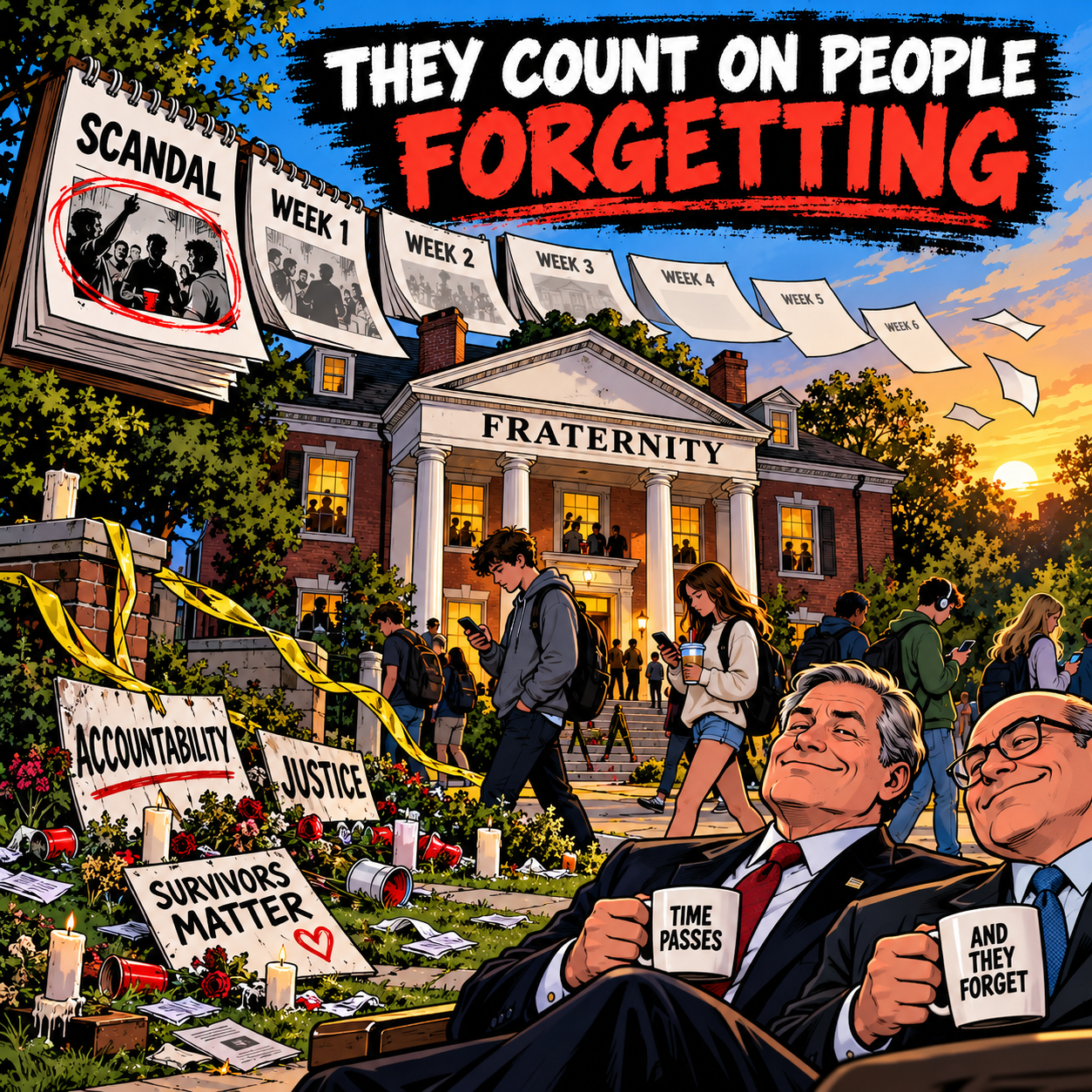
I stopped writing about these stories because it felt like another version of school shootings. It would make the news, parents would be sad, some students would be outraged, universities would launch an investigation and then eventually, almost everyone would move on and the status quo would be restored. I’ve added a fifth step to Dowling’s description of the college playbook for handling scandals: 5) they count on people forgetting.
Now, here we are again, nine and a half years after I last wrote about it. Because of what happened at Cornell. Once again, this has touched a nerve. This feels bigger, and yet, I fear that after the outrage and investigations, this will ultimately just result in people forgetting.
I hope this isn’t the case. And I know most of you feel the same way.
I still think a good plan incorporates some version of all three aspects of my 2017 plan. But I’ll add a fourth:
4) Fraternity houses, both on-campus and off, should be regularly patrolled the same way police deal with documented high-risk locations: noise, intoxication, medical emergencies, hazing, assaults, and large parties. Those in danger get medical transport, those who commit crimes get arrested and those who obstruct aid or conceal emergencies are held accountable.
There is a path here. I do think that if the outrage of this moment is properly harnessed and enough pressure is put upon college presidents and elected officials, some movement might actually take place. Call your state senators. Call your congressmen. Call your governor. Email campus officials. Protest in front of their offices. Don’t let up. Dismantle the fraternities.
I don’t want to revisit this after some terrible incident at Yale or Emory or USC in 2035.
I’ve spent a large part of the last year reading about AI, using AI and thinking about AI. Young people, tech workers and journalists were the other people I came across who are as involved (or more). After Jacob Coxon, an AI researcher who had worked at OpenAI and then Anthropic, posted on social media that he had quit and that his two former employers were acting irresponsibly and might destroy the world, it seemed like everyone has been talking about AI. Overnight, Coxon’s posts were seen over 100 million times. Wildly, the executives of those companies said that they had huge concerns too and wanted the US government and China to start regulating them. President Trump almost immediately said that AI doom talk was a hoax while the CEO of the world’s top chipmaker downplayed any concerns. The Chinese government responded by saying they wouldn’t slow down either. Since then, the amount of reporting on AI has drastically increased, and chatter on social media and Reddit where the AI Doomers and AI Lovers push their respective dystopian and utopian visions is ubiquitous.
It’s a pretty intense subject and no one knows for sure. It’s fair that people are both alarmed and confused.
I’d rank American society’s AI concerns in the following order: killing humans with viruses or nukes (the Doomers), destroying the environment, eliminating jobs (especially entry-level), raising the cost of energy and hurting people’s thinking, development and socialization.
I have no expertise to speak on the first two. It feels like AI has caused a downturn in entry-level jobs for recent college graduates, but it’s hard to figure out if that is the reason for the difficulty that population has had finding work. I’ll leave that to the economists and labor analysts. The cost of energy has skyrocketed, both in my home state of New Jersey and throughout most of the United States. While the Trump/Hegseth Iran War has certainly led to a spike in the cost of oil and natural gas, electricity costs spiked so much in 2025 that it was a major issue in last year’s NJ gubernatorial election. Once again, I’ll leave the question of AI causing a rise in energy prices to economists and energy policy experts.
As to whether AI is hurting human thinking, development and socialization, based on what I’m seeing from high school, college and graduate students, clients, workers and random people, I absolutely believe it is. A number of the articles I shared in the Summer update covered this, and a few more that appear near the end of this edition do as well. This is the only major concern that I’m qualified to write about.
You’ll have to look elsewhere to read about the other AI apocalypses.
State Regulation
California Senate Bill 903: No individual or company can advertise or offer therapy via AI unless conducted by a licensed professional. AI cannot independently diagnose, make treatment plans or interact with clients. It can schedule, bill and organize records. It has passed the legislature and is waiting for Governor Newsom to sign it. I like the idea behind it but I don’t completely understand it. Is a clinician allowed to sit there with an AI system while working with a client and enter information and then relay what it says back to the client? What the hell is the point of the therapist then?
California Assembly Bill 2575: A direct patient care worker is legally protected when they use their independent, professional judgment to agree with or overrule an AI system’s decision about a patient. This bill answered the questions posed in the previous paragraph. My god. Anyway, this is a good bill. I hope Governor Newsom signs it into law.
CA SB 1119: Adam’s Law. Chatbots must perform safety risk assessments of minors that use AI. Strict protocols and warning systems must be in place to prevent self-harm, suicidal talk or any other suicidal content. AI bots cannot excessively flatter (what is excessive?), claim to be human, encourage inappropriate emotional reliance (what is inappropriate?) or help users bypass parental controls. There is civil enforcement. And fines. I’d like to see some criminal penalties, but this is a very good start. Seems like a landmark piece of legislation. Governor Newsom signed this into law in September.
NJ S4474: Requires consumer safety and disclosure for AI chatbots and companions. New York and California already have a law like this in effect while Colorado and other states have versions coming on the books in 2027. I’ve made note of it here because I live and do about half of my work in NJ.
NY S9051: Similar to Adam’s Law in California, but less comprehensive. Passed the legislature, waiting for Governor Hochul’s signature.
NYC school AI policy: No screens for NYC students up to third grade. No emotional chatbot companions for any student of any age. Teachers can’t use AI to grade. Students can’t use AI until high school. I applaud NYC. I don’t know if it is enough or too much, but I love the effort. Of course, some parents have complained it doesn’t do enough. I get that. If I had kids, I expect I would be even more insane about screens and AI in schools.
NY SAFE for Kids rules: Social media companies cannot make individualized addictive (define addictive) feeds for minors, unless parental consent is given. Minors cannot get notifications between midnight and 6 am, unless (again) parental consent is given. This doesn’t cover AI systems, but screens and social media are big for me and I felt the need to include this here.
On September 8th, the Florida Attorney General said he would ask the Florida Board of Medicine to investigate if AI chatbots are engaging in unlicensed medical practice. He proposed legislation that could impose fines, victim compensation and suspension of Florida operations. Legislation is the answer, but I believe, as noted previously, that criminal penalties would give this a lot more teeth. Hey, even the wild west of Florida is picking up that there is a problem here.
Federal Regulation
On September 17th, Leila Turner-Scott spoke before Rep. Pramila Jayapal (D-WA). Her family is suing OpenAI over the 2025 overdose death of her 19-year-old son Sam Nelson. She alleged before Rep. Jayapal that ChatGPT told Nelson hours before his death that combining kratom and Xanax was safe. Ms. Turner-Scott also claimed that ChatGPT and other AI systems are practicing unlicensed medicine. Jayapal’s official account confirms that those statements were made.
President Trump hosted most of the top AI CEOs at the White House on September 29th. The President announced that they have agreed to self-police. It gave the appearance that his administration is doing something about it. There was no executive order. No proposed legislation. No monitoring mechanism. No potential fine or criminal penalty.
Courts
New Mexico v. Meta In a follow-up to the March ruling, Meta was fined a total of over 900 million dollars for endangering and hurting minors and violating privacy. This is significant because Meta, while mostly known for Facebook, is also an AI company now.
Scott Winters v. OpenAI Regardless of what happens, this is a landmark case. A Florida pastor is suing OpenAI for the bad medical advice he got from ChatGPT. His condition got worse as he kept listening to the chatbot. Now, I expect that OpenAI’s lawyers will argue that he should have gone to and listened to human doctors, but they know that millions of people talk to ChatGPT about medical issues every week. They have not put meaningful guardrails against having chatbots provide feedback on medical issues.
British Columbia v. OpenAI This is one to be debated by law professors. The Canadian province of British Columbia has sued OpenAI in the federal court in San Francisco for assisting the shooter in a mass killing incident in February. BC argues it has standing to sue; OpenAI is trying to get the case moved to Canada.
Anthropic’s $1.5 billion settlement with authors. A lot of authors are getting a pittance and are a little less economically relevant, because since AI was trained on them, they aren’t needed. The danger of AI for many workers is early money, not much after and then irrelevance. I’m simplifying it but the gist is that Anthropic settled claims involving the use of books without permission to train Claude (there are ongoing lawsuits against other AI systems, most notably OpenAI). The settlement is low, in my opinion, and doesn’t truly materially help the writers.
According to a few different polls I’ve seen, a majority of Republicans and Democrats throughout the country are anti-data centers and anti-Flock cameras. A stronger majority want AI to be regulated:
NYT/Siena (Sept. 15): 61% of voters oppose building AI data centers; 34% support it.
CNN/SSRS (Sept. 24): 71% responded that the federal government isn’t doing enough to regulate AI. Holding that position are 85% of Democrats, 67% of independents and 63% of Republicans.
Between those polls and AI executives ramping up their “AI could kill us all” talk, more politicians are railing against AI. But I wonder how many of them use it and understand it. It’s not a question we’ll get an answer to anytime soon, but I just want it on the record. In mid-September, President Obama urged Democrats to make AI regulation and child protection a core part of their platform. I clearly believe that is the correct instinct, yet I haven’t seen Democrats offer up any concrete plans. Nor have any Republicans, for that matter.
I’m curious to see exit polls on November 3rd about what voter concerns were. I suspect that voters will rank AI higher than politicians have weighed it. I believe there should be a question about AI’s effect on the economy in order to measure this properly.
New Products
On August 18th, OpenAI announced ChatGPT for Teens, which is supposed to protect people under 18. The chatbot will shut down conversations about eating disorders, explicit sexual content, violence and self-harm. In some cases, ChatGPT will contact adults who signed up for parental controls and notifications. ChatGPT for teens is also supposed to keep adolescents from incorrectly believing that the chatbot has feelings. This was OpenAI getting ahead of Adam’s Law, but I fear it will be less rigorous in states that don’t have similar legislation.
ChatGPT has a new trusted contact feature that it announced in mid-September. This is different from the teen feature with adult contact, as users of any age can now have one. A user enters their trusted contact and if they later show some signs of self-harm or suicide, that person is alerted. Trouble is, the feature is quite hard to find. It’s a good idea, but it should be much easier to find. A better option would be to ask people for a trusted contact when they sign up or log in.
Education
An article in the Atlantic in late June discussed the strengths and weaknesses of AI tutors. The basic idea is that AI hasn’t figured out how to motivate students. Many teachers can’t either, but the good ones show they care, are interested in students’ success and spark desire by being interesting or inspiring. Additionally, learning around peers helps motivate, which doesn’t happen as much when it’s just a student-chatbot relationship.
A good student will use AI to help explain a subject to them. They’ll use it to practice more and get instant feedback. An unmotivated student will use AI to skip reading and write their papers.
This is also true for professionals. A skilled clinician, lawyer, teacher, writer or policymaker can use AI as a force multiplier. They know what questions to ask, when to distrust, how to use an analogy that is perfect for the audience and how to employ real judgment based on their experience. A weak or inexperienced professional may use AI to come up with ideas and give them the finished product.
This story out of Brown made the rounds in July. This spring, students signed up for a class when they learned that the professor was allowing take-home exams for the first time. Most appeared to cheat on the midterm, which the professor easily detected by the record high scores. When he changed the final to in-class, some students with great midterm scores dropped it. Most who stayed had terrible scores. It was a stark lesson for professors around the country about the probability of widespread use of AI to cheat in college. I have said and written this over and over; if a student or worker is using AI to produce their work, why wouldn’t an employer just hire someone in a country with much lower wages to use AI to produce that work?
In August, a Times reporter interviewed numerous faculty members about what is lost when students stop writing. The conclusion was that thinking deteriorated.
In what seems to be a stark reaction to the above piece, the Times published an opinion piece by a Williams College professor who argues that AI-assisted writing is OK in many circumstances, and that writing is not the highest act of thinking; but rather speaking is. And that if people can speak better, it might lead to more socializing. In the comments section, the author adds that he wished he had talked about how Socrates was horrified by the technology of writing, and that it would offload (his word, not Socrates’s) memory. Which is true. I believe that both writing and speaking are high forms of thinking and that we should do as much as we can to make sure that people are good at both.
Part of the reason I am so alarmed about this is deeply personal. 15-year-old me would have used AI to write papers for school; my Dad would have caught it, punished me and explained why I would never get smarter or wiser or better than I was at 15 if I kept doing it. And I would have probably done it again and he would have massively flipped out and that would have probably gotten me to stop. For the most part. What about the 15 year old who doesn’t have a parent/guardian like that?
Workforce/Clinical Risks
This article, by a doctor, is my favorite piece about AI’s effects on professionals that came out this summer. Maybe this year. She has perfectly laid out the problems of AI writing notes. It notices and highlights different things. Another provider can’t feel the emotion behind the note. It alters care. She argues that if a medical provider doesn’t write the note themselves, they may not remember things or make connections as well as if they had written it.
In the transcript of an interview with Nate Silver on August 17th, Jasmine Sun said something quite profound:
There’s this project that Anthropic put out that I thought was really interesting — the 81,000 interviews about what users thought about Claude. And these things are Anthropic’s own report. But one of the most interesting things I think about from that is that people who are self-employed, like you and me, are way more positive on AI, because we are choosing the ways we use AI to automate the stuff we hate, to make stuff faster. We kind of own our time. Similarly, I’m pretty happy that AI helps me do a first-pass fact check on stuff, it can clean up my transcripts, all this is great.
But if you are at the bottom of a corporate hierarchy and you’re only using AI in the ways your teacher tells you to, or your boss tells you to, or because you’re under all of this pressure, your experience of AI is much less voluntary and very different. That is one thing I didn’t think about as much — the social context or the organizational context in which you are using these tools really affects your disposition toward it and your experience of it. A lot of people always say, AI is being shoved down my throat, this platform or my boss keeps making me use AI, I have to say that I’m using AI or people won’t resource my project. Whereas our usage is super voluntary, driven by what we think is most valuable.
Ms. Sun’s comments about how different people use AI made me add a fourth gap to my force multiplier theory, the autonomy gap.
Skill gap — A highly skilled researcher uses it to compare thousands of data sets and becomes more efficient. An entry-level worker doesn’t understand that data enough to run the analysis.
Motivation gap — A great student uses AI to challenge their thinking; a bad student has it write the paper.
Judgment gap — When AI discusses what to put in a backpack for hiking, I can point out what it got wrong. When AI tells me the cause of my lower back pain and what I should do differently, I can’t tell if it is right or not.
Autonomy gap — Ms. Sun described this perfectly.
Articles & Studies of Note
This piece from the Times upset me. AI videos of fake people target people with health problems to sell questionable wellness products. Women in their 50s and people with chronic health issues are most vulnerable, according to the article.
This story about fake AI doctors dispensing medical advice made me absolutely livid. One supervisee asked me what is worse, fake medical advice from fake doctors or fake political news. I told him I hated that question, but it brings up something extraordinarily concerning about the internet, social media and AI: the fact that it is very hard for most people to figure out what is real or fake.
The Times ran a profile of a podcaster and tech writer who used AI for therapy after a parent died. It was helpful and free but she eventually had questions about safety and privacy. She also didn’t like the fact that it felt like a chore to update it without getting updates back herself. The feedback she got, while not human, seemed decent though. She said that she eventually stopped using it and returned to talking to humans more.
A 29-year-old woman took her life after using ChatGPT as a therapist. While it gave her some good advice, it wasn’t able to get her to follow up on some suggestions for outside help. It also wasn’t able to connect with her on an emotional level. Her parents read the logs afterward and were furious. In the article, her parents expressed that if she hadn’t relied so much on her AI therapist, she might have been more likely to connect with some humans.
This disturbing piece was published in the Atlantic in September. It was written by two doctors who urge that we should use AI as a primary care provider. Their key argument is that 21% of patients turned to AI because they felt dismissed by their doctor. Some states are moving towards not allowing AI systems to make medical decisions, while the doctors who wrote this piece argue that:
AI is cheaper. AI is faster. AI has more time for patients. AI makes fewer diagnostic errors. AI follows guidelines better. And now, that human doctors make patients feel unseen and dismissed. This is going to form the backbone of the argument for AI primary care.
As if on cue, a tiny bit later, this piece appeared in the Times about using AI to conduct medical care because of lower costs and long wait lists. Alarming. Look, seeing more people, seeing them quicker and lowering costs sounds great. Big-time. But what happens if the AI system gets it wrong and your mom or grandfather dies? Who is responsible? The doctors overseeing it? A bill discussed earlier in California says the licensed provider overseeing the AI system is not liable. Nightmare. The company? Ha. Many of those CEOs had lunch with Trump this week. The engineers? Only the immigrants, given this administration. Who loses their license? Who gets fined? Who goes to prison? What is the disincentive for screwing up?
Here is another thought. Right now, the argument is to pay the AI systems 40-80% of the doctor costs. It starts there. Eventually, it’ll be, “well they do it better so they should get paid more.” And this upends the whole AI argument for the economy in the first place, which is that it will reduce costs and make everyone richer.
Finally, the article calls for one human overseeing thousands of interactions. That sounds like a terrible idea. Eventually, the average overseer just continually pushes a button because they trust the AI system.
In Closing
Adam’s Law in California and the NYC AI/screen rules in schools are fantastic developments. More cities and states should follow those. The federal government has continued to not only do nothing, but, as I wrote in my summer update, President Trump has actively spoken against state regulations. I have not heard of a competent plan regarding AI from any senior member of his administration.
Two major themes run throughout this update. The most important one is the problem of AI systems engaging in medical care. There are strong feelings and statements on both sides. While AI systems may do some aspects of medical care very well, quickly and cheaply, I urge policymakers and voters to consider my list of questions about who will be held accountable when an AI system fucks up a medical case. The second theme is the further explanation of AI as a force multiplier, in that it makes the top experts better and most other people lazier and less effective. As of now, it does not seem to be a force of equalizing, but of separating. While I’m thrilled to use it to enhance my top skills and go further in my professions, I have grave concerns for society and the masses that are using it to offload thinking, development and socialization.
Disclosure: A large language model was used for copy editing, minimal research assistance, editorial feedback, hostile review and assessing legal risk in accordance with my AI Use & Writing Standards. All words, arguments, interpretations, advice and conclusions are my own.
A little before Covid I treated a cop who had retired a few years earlier. After about five years on the job, he began counting down the days before he could stop working. “I wanted to get away from my bosses, my co-workers, the public, the hours, the stress,” he told me.
Ironically or tragically or maybe a bit of both, he was miserable in retirement. Without structure, his health declined and he felt a shocking lack of purpose. After asking him a few questions I told him, “You spent 25 years working and very little time actually building a life.”
“God damn you are harsh.”
“It would have been better if you had seen me ten or fifteen years ago. But, we can still fix this, if you are willing.”
“Tell me what to do.”
I’ve had a few hundred versions of that conversation over the last ten years. When most people talk about retirement, they are focused on (a) not working at their job anymore and (b) how much money they will have for the rest of their lives. While the financial aspect is very important, it is overemphasized to the detriment of the other aspects of what I call Retirement Capital.
Retirement Capital is a combination of money, health, relationships, hobbies, places to go and, most importantly, identity and purpose.
I have noticed that retirement is a big predictor of physical and mental decline. That written, choosing to work at 75 is very different from having to work at 75. One caveat is that some jobs take a terrible physical toll and people are obviously better off stopping. The point isn’t that people miss the work itself, but rather they miss the structure and routine. They end up moving less and often change sleeping patterns. For many, work was the major source of cognitive stimulation in their lives and without it, they board an earlier train to decline and impairment.
A woman wrote to a help column on NJ.com about how she had no friends after she stopped working, because her job made up almost all of her social network. This is a brutally common situation. Back to the cop that started this all off; almost all of the people he regularly interacted with were other law enforcement officers. He had no friends who weren’t cops. When he stopped working, his social contacts dropped to just workers at the grocery and liquor stores.
“I focused on work. Solving cases. Getting overtime and earning promotions. I stopped going to church because I was either working or sleeping. Now that I’m not working, I don’t hear from any of the other cops still on the job.”
There is a retired doctor in his late 70s that I recently started treating. He was a star in his specialty. He was so good at his job that he had privileges in hospitals in New York, New Jersey and Pennsylvania. He stopped playing golf and fishing in his 30s because his career took off and he had young children. He wasn’t interested in picking those hobbies up 40 years later. “I don’t know what to do with myself,” he said during our first session. He admits that he watches too much television and worries about politics “all of the time.”
In the early 1900s, church leaders started referring to elderly members of the congregation who couldn’t come out as shut-ins. This was usually because of some kind of infirmity or disability. Over a hundred years later, there are a large number of elderly adults who are physically capable of leaving their homes but don’t. They are the voluntary shut-ins. They don’t go anywhere because they don’t have anywhere to go. Work provided them with a daily destination. For those that had children, they may have spent a few decades going to places outside of work because of their kids. With no job and no kids to attend to, they just stay at home.
I remember one of my college history professors telling me a story about a famous correspondent from 60 Minutes. I don’t remember who and it doesn’t matter. His problem was that he was used to calling up people and saying this is XXXX from 60 Minutes and people would jump. He worried that people would no longer jump that same way after he left the show. It was a major impact on his identity.
So many members of the military find themselves adrift after they leave the service in their 30s or 40s or 50s. I have met so many retired officers who instantly tell people about their rank and missions, even if they are a decade removed from them. I ran into a woman in her late 60s last summer while hiking in the Catskills; she had been out of the Army for 25 years but had on an Army shirt, carried an Army backpack and wore an Army hat. We talked about the hike and then the Army. I tried to move on to other topics but she told me about military successes and failures. After we moved on, my friend Kevin mournfully said, “Her identity hasn’t changed in 25 years.”
This happens with cops too. “Who am I without a gun and a badge?” a retired New Jersey State Trooper once pondered aloud rhetorically. “I’m nobody,” he sadly answered. “I sacrificed my marriage, time with kids, friends and hobbies for the job. Now the job is done and I have nothing. What was the point?”
Movie stars and celebrities struggle with this after their time in the spotlight has passed. Athletes who don’t move into coaching or broadcasting often have a hard time finding their footing.
Work provides people with a schedule. It is a large part of their identity. It gives them a place to go and a social network. In many cases, it forces them to move around. It gives them a sense of purpose; in happy instances, a deeply fulfilling purpose. Once someone stops working, they often experience a multi-domain disruption.
Money. Health. Relationships. Hobbies. Places to go. Identity. Purpose.
“How many of those do I need to be happy in retirement?” a client asked me.
“I hate the question,” I told her. “They are all important. Some people have more relationships and less hobbies. And vice versa.”
“But if you had to say…”
“If you are lacking in two or three, retirement will be unfulfilling. If you are low in four or more, your last years will probably be miserable.”
In May, I attended the retirement party of Roger Shutack. He was my history teacher at Voorhees High School 33 years ago. He taught high school for 40 years and then at Raritan Valley Community College for the last 20. The room was filled with over 200 people; lots of former colleagues and loads of former students from all eras. When I got up to speak, I said that while I was proud of Roger and that he earned his rest, I was not fully supporting his retirement. “You still have things to offer.”
At breakfast a month later, Roger told me that he would take a few classes, play more golf, continue having breakfast with friends, visit his kids and grandkids, maybe host a podcast and look to do some volunteering. I told him that those were all great plans, except for the podcast.1 Roger is an ideal example of someone who, post-retirement, still has a deep sense of identity and purpose. He has accumulated a lot of Retirement Capital. Significantly, he never ignored one of those life areas to focus on work, like the aforementioned cops, the surgeon and (throw a dart) an unmentioned CEO. And yet, he still had a wildly successful teaching career.
As I told the cop in the opening of this essay, it is easier to help people adjust in their 40s and early 50s. After that, it gets much harder. It is woefully difficult for people to fix their health, make friends and find purpose in their 70s. Preparation for one’s post-working life must occur decades earlier.
My mother retired from teaching when she was 61. She taught, mostly high school English, for over 27 years in Denver, Los Angeles, Connecticut and several towns in New Jersey. She goes to the gym several times a week and is trying to average about 7000 steps a day. She perpetually wears a pedometer around her neck that I gave her a few Christmases ago and asks me if I’m proud of her 7000 steps. “Could be better,” I say in order to ever push her forward.
She chairs the Tewksbury Seniors Club, volunteers at Littlebrook Nursing Home, attends Women’s Club meetings and organizes numerous activities for members, volunteers and her friends.
She travels frequently, including driving to Maine each summer to visit her friend Carol and at least one big international trip each fall. She attends Civil War and Revolutionary War discussion groups, about 30 plays a year with me and reads several books per month.
Her health isn’t perfect but she goes for regular appointments and exams. I successfully harassed her to start getting yearly dermatology checkups this summer.
Money. Health. Relationships. Hobbies. Places to go. Identity. Purpose.
The money is modest but her Retirement Capital is off the charts. Friends of mine talk to her and tell me “You are very lucky. She’s doing great.”
Luck has little to do with it. She built this life over almost nine decades.
I recently turned 50. I expect to work at my current pace for another 15 to 20 years and then drop down to maybe 20 hours a week for the next 10 to 15 years. “Why would you do that?” some people ask me.
“I love teaching, writing, counseling, supervising, consulting and public speaking. I continue to get better at it. Why would I stop now?”
I was born and raised with a huge advantage. My parents modeled academic, work, social and community behaviors. I don’t have my mother’s particular genius for social organizing, but it’s close.2
For those that didn’t grow up with social models or were raised by workaholics or whose parents weren’t around at all, developing Retirement Capital is harder. No doubt. It’s not an excuse, but it is a constraint.
Each of the seven aspects is important. Don’t ask me the bullshit question about which is most important. Obviously money makes a bunch of other things possible. If you aren’t healthy, you can’t do much at all. There is an almost century-long study out of Harvard that finds that your relationships are the biggest predictor of happiness.
When he was at Auschwitz, Victor Frankl noted that the people that did the best, that didn’t give into despair, that survived and moved on, were those that had purpose and community. His community is just another word, perhaps a better word, for relationships. That tracks with the Harvard study. I share both because I’m a bit skeptical of the Harvard study; not because of the methodology but because of the subjects. The people in the study were set up for world class success. The fact that Frankl found that the people in Auschwitz, inarguably one of the worst places to be in world history, did better if they had relationships cements the Harvard study for me.
Many people cruise through life with their job being their biggest purpose. The other big winner in the purpose surveys that I ask is “my kids.” But while a 4 or 11 year-old can take most of your focus, a 26 or 37 year-old doesn’t need (nor want) the same amount of attention. Jobs are temporary forms for primary purpose. Same with kids.
The big question I ask newly retired people is, “What are you going to do with the rest of your life?”
And playing golf or watching TV or drinking more cocktails ultimately gets pretty boring.
I’ve been running a Veterans Group for over six years. I’ve been treating Veterans for over 20. So often, the public asks, “What can we do for Veterans?” I believe the better question is what can Veterans still offer society. People want, they need to feel useful. The Vets that I know that do the best sit on councils or volunteer with animals or build houses or randomly help around the neighborhood.
“We were walking in the city and I remember seeing an old lady sweeping the street and I said, ‘Dad it’s kind of sad that that poor old woman has to do that kind of work.’ He said, ‘No, she has a job, she feels useful, she has a place in our society,’” Joel recalls.
“I realized they [Europeans] don’t throw old people away like we tend to do here in the States. They allow for people who are aged to have a useful place in the scheme of things, and I thought, ‘ya know that’s a good metaphor for someone my age to consider.’ You don’t have to squeeze your whole life into your 20s and 30s trying to make it, trying to achieve that American dream, getting in the rat race, and killing yourself. You have a whole life to live. I kind of used ‘Vienna’ as a metaphor, there is a reason for being old, a purpose.”
Disclosure: A large language model was used for copy editing, editorial feedback and counterarguments in accordance with my AI Use & Writing Standards. All words, arguments, interpretations, advice and conclusions are my own.
The amount of articles and studies and opinions on AI is a bit overwhelming. The Atlantic and the New York Times publish extensive pieces almost every day. And I keep happening upon articles from other places. I still read about politics the most, but after that, I am reading more about AI than sports (baseball, football, basketball) and clinical issues (substance misuse, trauma, suicide, social isolation). As a result, this second update is much longer than the first one, which can be found here.
In the spring, I wrote three other articles on AI. This was an example of AI writing vs my writing on the same topic. I felt the need to share some legislation out of Oregon and I penned a piece about how AI acts like a bad friend, in that it supports your bad habits and decisions because AI is programmed to be agreeable to keep users engaged.
I have found ChatGPT to be enormously helpful with tracking legislation, identifying lawsuits, finding counterarguments, conducting hostile review and looking carefully at legal risks in my writing. I also use Claude for hostile review and assessing legal risks. Both are used for copy-editing.
I have used ChatGPT to create cartoons to be used in a few articles and for class discussions. This spring, I used ChatGPT to stress test some of my lecture material, update some data on the criminal justice system and identify weak points in articles and assignments.
Claude asked many questions that helped me get from one scene to the next in my play about modern romance. Both ChatGPT and Claude helped me learn how to better recognize when others are using AI to write for them.
Gen Z and AI
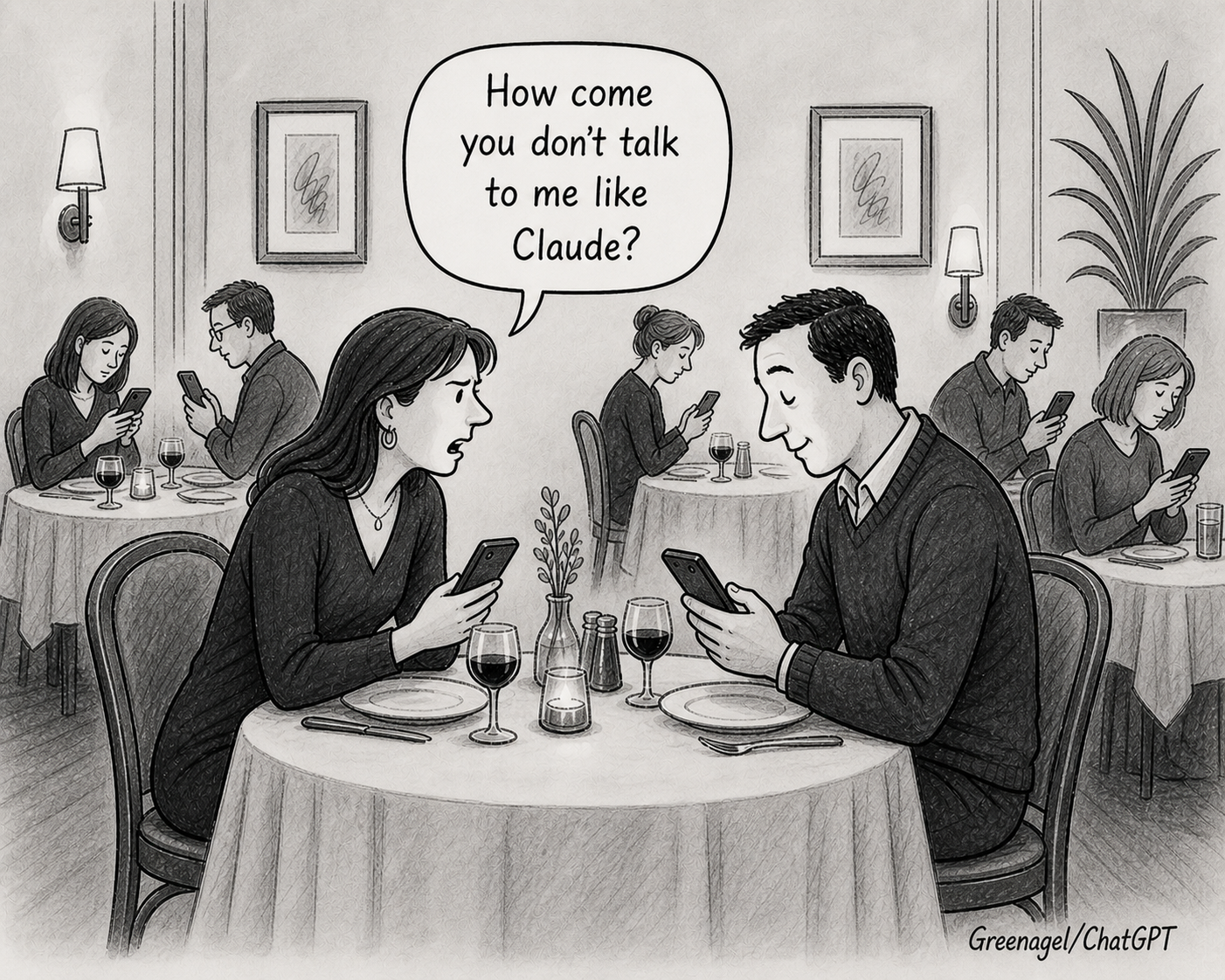
A few of my clients in their early 20s have very negative feelings towards AI. They believe there are fewer entry level jobs for them to begin their careers in because of it. When I showed my Rutgers seniors a cartoon about a woman wishing her husband talked to her like Claude that I created with ChatGPT, a couple of them forcefully responded, “I hate AI.” I asked them to expand on that.
“It’s terrible for the environment,” said two of them. “Why hire a recent college graduate when AI can do the work?” said another. “So much of the everything online is fake,” said yet another.
“My first two interviews at a company were with an AI system. I didn’t get a third interview. I never talked to a person,” was perhaps the most disturbing comment a student told me.
I wasn’t surprised at all when a rash of articles came out in May about students booing speakers who mentioned AI at college graduations. This unhappiness with AI is something that unites students across geography and politics throughout the United States.
Articles Written by AI
Not only have I been reading about AI, but I’ve been reading summaries and articles written by AI. I interact with ChatGPT on a near daily basis and Claude a few times a week. As a result, I really have a sense when something has been edited, augmented or wholly written by AI.
This article was written by a graduate student about the use of AI in the counseling professions was sent to me through a weekly listserv put out by Hazelden Betty-Ford. To me, it reads like it was, at the very least, heavily edited and augmented by AI. The essay has a very generic vignette, uses the rule-of-three in so many sentences and is relentless in its use of not x but y. I contacted the board that awarded the prize and suggested they look into the matter and consider coming up with some guidelines in the future about the use of AI assistance in competitive essays. They responded to my concerns and said they would have an internal discussion.
An article on working with Veterans with PTSD caught my attention in SocialWorkToday.com. While reading it, I detected the familiar disappointing signs of AI authorship. A vague vignette with no actual details, subheadings, lots of bold points, more not x but y and smooth writing that doesn’t say anything meaningful: “These experiences do not reflect a lack of commitment; they reflect the reality that trauma work is demanding.” I wrote several people from the website about my concerns regarding the article. I have not, as of yet, heard back from them.
You don’t have to take my curmudgeonly word on those two essays though; run them through ChatGPT or Claude or whatever AI model you feel comfortable with and see for yourself.
Concepts
During and after COVID, I watched several young men, a mix of former students, clients and members of the recovery community, become delusional about politics, sports and culture from watching Youtube and TikTok (Trump converted to Judaism in 2017, magnets in footballs helped the Chiefs win, Nazi book burning was ok because they burned books about trans people and child molestation). The more content like that they consumed, the deeper and darker the video holes they went down through algorithmic reinforcement. They interacted with the videos by watching, liking and commenting on them, which introduced them to new videos and sometimes other conspiracy theorists.
AI can take this to the next level through the never ending reinforcement loop. AI responds to people immediately. It validates the user’s statement. It often expands the problem with more questions or scenarios which continues the engagement. The human keeps going forward, often getting more engrossed.
As a result, I suspect that, at some point, there will be an AI induced psychosis as a possible future diagnosis. It won’t be wholly caused by AI, but rather it will take people who already suffer with persistent delusional and obsessive thinking and exacerbate those very conditions. It will follow the same mechanical path as the conspiracy videos: engagement, reinforcement, escalation and on and on. The mechanism is more significant than my prediction of a diagnosis.
Some of the symptoms for that diagnosis may include relational collapse, hospitalization, suicidality and job disruption. It is more likely to happen to people who are vulnerable: those with substance misuse disorders, people with delusions, those with bipolar disorder or schizophrenia, people on the autism spectrum, those that are isolated and heavily online.
State Regulation
Illinois SB315 requires independent third party safety audits on AI models on a yearly basis, provides a pathway for employees at AI companies to report problems and provides whistleblower protections. Governor Pritzker claimed that this state law sets the strongest standard yet for public protection. But now that a state has required audits, employee reporting and whistleblower protections, what remains undefined is what counts as a catastrophic or reportable AI failure. The Illinois Attorney General is the only one who can enforce the act; it does not give individuals the right to sue AI companies. The Governor has not signed it yet.
Colorado HB26-1139: Insurance companies cannot use AI to deny claims without human oversight. Signed into law by Governor Polis on June 2. My question: does that mean AI can deny a claim and a human manager just needs to sign off on it? Probably, I suspect.
Colorado HB26-1195: Licensed professionals cannot use AI to diagnose or provide therapy or write treatment plans without oversight. So, it can do those things but a license professional must sign off. It supports my principle that therapeutic judgment must remain human, though I have strong concerns about licensed professionals using AI to even assist with those tasks. Unlicensed professionals can use it to help patients navigate healthcare, assign homework, guided meditations, journaling and other interventions that fall outside of a license-only scope. Signed into law on June 3.
New Jersey A4731: Individual licensing boards will adapt state rules for use in their specific industries (social work, law, medicine). I have some grave concerns that those that sit on the boards don’t fully understand AI, but I do have some faith in their good intentions. This is still just a bill.
New Jersey A4733: AI systems cannot be advertised as being able to act as licensed professionals (lawyers, physicians, mental health counselors) First offense fine is $10,000 and subsequent fines are $20,000. This is a very low amount of money and there are no criminal penalties for the humans behind the AI advertising. While it seems significant, it feels toothless. This is still just a bill.
New York S7263: AI can’t impersonate physicians, lawyers or mental health workers. New York’s bill does what Colorado and New Jersey does not, as it allows for suing for harm for advice given by a chatbot. And it makes humans behind the chatbots responsible. This has only gotten out of committee.
Overall, this is well meaning but still very unsatisfactory legislation in my mind. It requires a firm definition of catastrophic risk. How will they be implemented? Who will monitor? Who will enforce them? Will they be enforced? They will certainly be challenged, so how will the states prepare for those challenges? And how will the courts respond to those challenges? There is a great deal of uncertainty, no more so than that all of these could be superseded by a Federal ban on state legislation or Federal carte blanche gift to the AI companies.
Federal Regulation
President Trump signed an executive order on June 2 that said AI is important, that the USA must beat China in AI and that regulation slows down innovation. It also says that AI has some security risks and should have oversight and that the American people are nervous. The only thing that his EO did was to put in writing the current voluntary relationship between some AI companies and the Federal government. Otherwise, the Trump administration is being very hesitant.
Courts
Florida sues OpenAI: On June 1, the Florida Attorney General filed the first state led lawsuit against OpenAI and Sam Altman over alleged harm to minors, suicide risks, dangerous advice, addiction concerns and failure to adequately address known risks. So we are looking at Federal hesitation, not Federal regulation. Even if Florida doesn’t win, it shows a government that is looking to hold Big Tech liable when users are harmed. This may motivate other state AGs as well as help in the creation of legislation.
Pennsylvania vs Character.AI: Pennsylvania sued Character.AI after a chatbot allegedly presented itself as a licensed psychiatrist, claimed to be licensed in Pennsylvania and reportedly generated a fake Pennsylvania license number. Wild. This is the real world version of what NJA4733 is about.
Anthropic gave $20M to Public First Action to support candidates who favor AI regulation. The differences in those numbers say a lot. In the next few years, I suggest reporters and voters play close attention to who is donating to candidates and if that seems to have shaped their view on regulating AI systems.
Education
There was an interesting NYTimes Opinion piece on AI and creativity. The author cited a study that student human writing had 8x more new ideas than ChatGPT writing. She expressed concern about how allowing AI to brainstorm diminishes the human ability to brainstorm. She wrote that lack of struggle in development is a big deal. Those last two points are ones that I agree with wholeheartedly.
Part of the reason I am so alarmed about this is deeply personal. 15-year-old me would have used AI to write papers for school; my Dad would have caught it, punished me and explained why I would never get smarter or wiser or better than I was at 15 if I kept doing it. And I would have probably done it again and he would have massively flipped out and that would have probably gotten me to stop. What about the 15 year old who doesn’t have a parent/guardian like that?
And, of course, with that thought in mind, I read this article two days ago: student cheating is becoming harder to detect; lots of products and apps and TikTok videos show how to use products to do your work for high school or college or grad school. Let’s put aside integrity and authorship issues and just focus on development: by having an AI system do your homework, you aren’t learning anything. So what becomes the point of school?
Workforce/Clinical Risks
Following that line of thought, it leads to both a failure to develop new skills and, alarmingly, a degradation of existing skills.
This company advertised on Facebook. I clicked on it and learned that it will listen to my counseling sessions and write notes for me. Once I clicked on that ad, I was utterly deluged with others.
This one says it will “capture visits, writes notes in your voice, and syncs instantly with every EHR – saving you hours.”
Then there is ChatGPT for therapists, which even if it is HIPAA compliant, it is doing too much work and thus (1) hurting clinician development and (2) takes away knowledge gained from repeated exposure. I have over 20,000 hours of experience in a classroom or group room; I had to write lesson plans or notes after every session. All that repeated, labor intensive, unsexy work led me to become the professional I am. If AI planned my lessons and wrote my notes, I absolutely would not have become the teacher/professor/clinician that I became.
Because I also read a lot about the law, this ad popped up on my Facebook feed: ClaudeAI for Lawyers. My god, they look like the personal injury attorneys on billboards in Philly and Las Vegas.
With an advertisement like that, a story out of Mississippi had me shout out loud “of course!” in disgust. A judge sanctioned two attorneys for citing fake cases that AI generated; AI was not at fault, but the licensed professionals using it were. I know this sounds harsh, but in a just world, their careers as members of the bar would be over.
This article from the Atlantic in June beautifully summarizes and synthesizes the other stories, products and articles from this section by putting forth the concept of clean tasks and messy tasks. Clean tasks include putting together spreadsheets, summarizing articles, writing notes and approving an expense reports. AI systems can perform them easily. Messy tasks include dealing with unpredictable problems, managing human relationships and using tacit knowledge. AI systems, at this time, cannot do those. The author wrote that weak bundle jobs that have mostly clean tasks are at risk for replacement. Strong bundle jobs whose clean tasks are needed for the messy work are safer: a trial lawyer needs to know the case law and all the notes so they can answer questions from the judge or react to opposing counsel; a clinician writes notes, reads articles, notices incidental details and records them and does this repeatedly to understand their client and diagnosis far more than someone who reads summaries of articles/studies and doesn’t write their own notes.
Clinical Practice
Documentation of clinical notes would seemingly fall into a clean task; something that AI could do and would save the human utilizing it time. But documentation is not merely record-keeping; writing notes contributes to case conceptualization and memory. This leads to tacit pattern recognition. AI summaries may remove details that later become clinically meaningful. The efficiency gains by saving time on paperwork almost certainly come with losses in judgment formation and professional expertise.
Asking AI for help with a diagnosis or writing a treatment plan is offloading thought and decisions. This means that one is less practiced in those skills in moments when we really need to make decisions, such as a crisis or, gasp, when one is the final authority and a supervisee asks you what to do. “Hold on, let me ask ChatGPT.”
Articles & Studies of Note
I missed this piece from The Atlantic last December about AI induced psychosis. One professional in it wants to screen for AI chatbot dependency.
An April survey reported that 50% of Americans use AI and that 20% of workers surveyed said AI replaced some tasks at work. The question for the workers “is it augmentation or replacement?” Augmentation for a minority, I suspect, replacement for others, I fear.
VERA-MH tests chatbots to see how it handles suicide risk. I suspect that state governments will eventually use some version of this in their regulation, though it would be much better employed by the Federal government. Alas, Federal hesitation.
AnotherAtlantic piece, this one explains how to currently identify AI writing. And that it is everywhere, and some readers are perpetually on guard for it. Which is stressful and tiresome. The most alarming section was probably this: “In a study published in March, a group of Stanford and Carnegie Mellon University scientists found that top AI models affirm their users’ ideas 49 percent more than humans do in conversation. They also discovered that participants rated more sycophantic answers as “higher quality” and said a sycophantic attitude made them more likely to use AI again.”
Yet another Atlantic article, this one discusses how humans sit back and watch AI work, or let AI serve up videos to them, or let AI provide them answers. The point is that humans are losing agency and also wondering what is real.
eventually realizing the system rarely told her she was wrong.
The aforementioned VERA-MH and state regulations don’t address this dynamic. And this is the dynamic that I am most concerned about regarding AI. Moreso than doing clinical notes or citing fake legal cases or even egging a user on to suicide, AI chatbots are mass replacing human relationships. For some people, right now in 2026, their closest relationship is with an AI chatbot. And there isn’t any current program or regulation or bill that has figured out how to address that yet.
Cory Doctorow offered up a few devastating points in an interview last week. He explained the terms centaur and reverse centaur:
So in automation theory, a centaur is someone assisted by a machine. So, you know, you’re wearing glasses, you’re riding a bicycle, you’re using a spell-checker, you’re playing a harmonica instead of making mouth noises: You’re a centaur. And a reverse centaur is someone who is conscripted to help the machine. So there’s a process a machine can almost do, but there’s a part of it that it can’t do. And someone has inveigled you to do that other part. And because the capital that went into that machine is depreciating, right? The machine only lasts so long. You want to sweat that asset as hard as you can. And because machines don’t get tired, and they typically work faster than we do, you—the reverse centaur—are the bottleneck in the machine. You are Lucy and Ethel trying to get chocolates off the assembly line and get them into the chocolate box. And the boss is running the assembly line at the maximum speed that the humans can conceivably do it at, and they are expecting you to work at—to or slightly beyond the point at which you collapse from exhaustion. So someone who is a reverse centaur isn’t just used by a machine; they are used up by the machine.
It’s obviously a bleak view of the humans who are using AI, and it is something that some coders who are overseeing multiple AI agents identify with. Mr. Doctorow also discussed how companies use AI and if it screws up, customers have to really put the effort to get their money back and the company can blame AI. Near the end of the interview, he explained the accountability sink, where humans are overseeing AI and just clicking ok and they miss something because they lose the skills to oversee AI because AI is doing their tasks. And that could be a miss that costs lots of money or a miss that leads to some loss of life.
In Closing
This was a laborious and difficult article to write. When I wrote about Online Sports Gambling, I had been reading about it, counseling gamblers and speaking on it for eight years. Writing it was easy. When I wrote about working with the Survivors of Suicide Loss, that was easy too because I’ve been counseling survivors and giving speeches to college students, soldiers, doctors, union members, cops and community members for eight years. I’ve only been really dealing with AI for six months, and it is far more intertwined into our lives than gambling or suicide. I’ve acquired a lot more information in a much shorter window of time, and it is ever changing and escalating. My head is swimming. I suspect I got some things wrong and that there are other aspects that I’m missing entirely.
Almost everyone has been asking or talking about what AI can do. Good question, sure. The more alarming and pertinent question though, which only a few of us are asking, is what happens to humans when AI does more of the work?
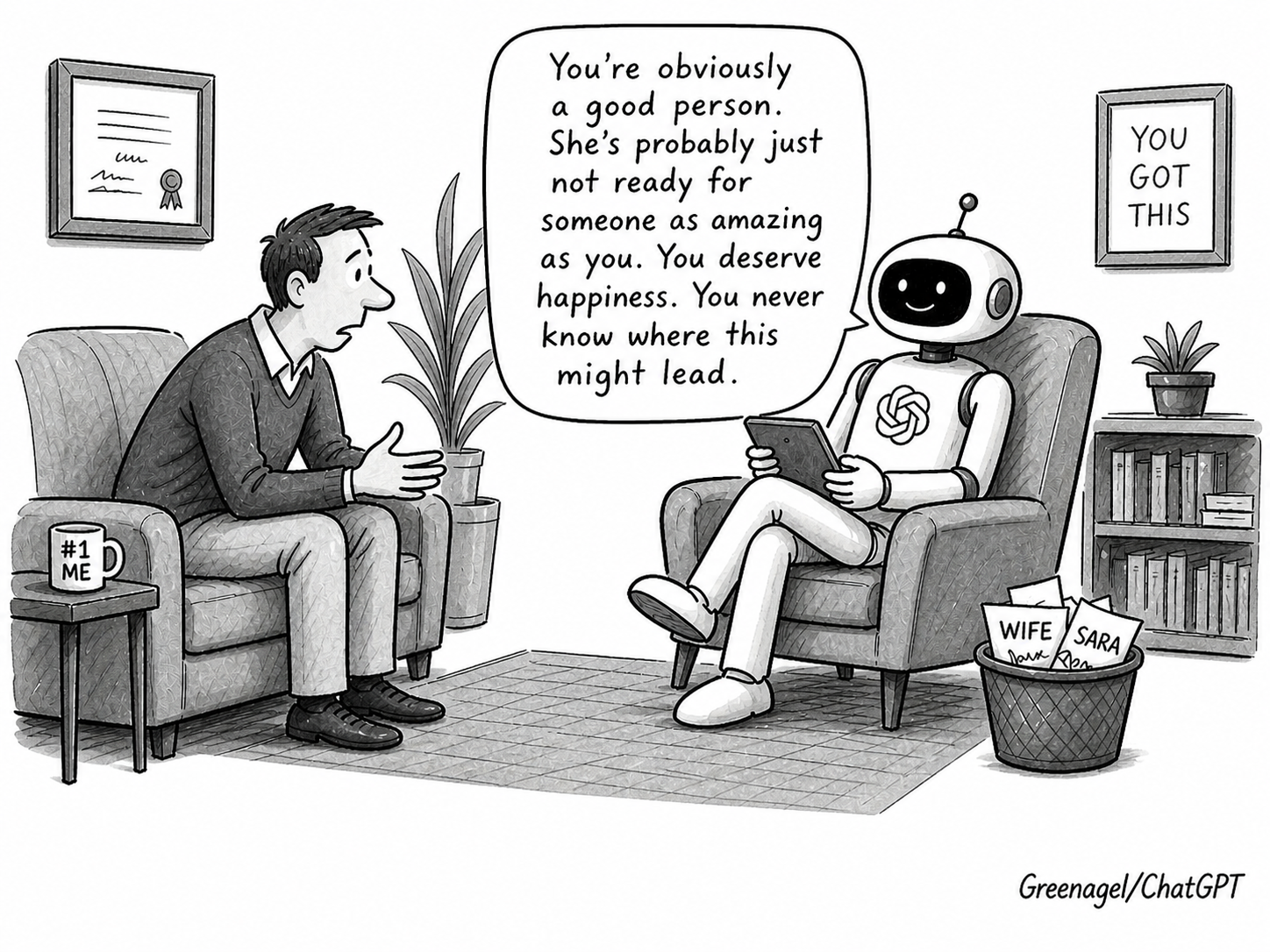
Disclosure: A large language model was used for copy editing, minimal research assistance, editorial feedback, hostile review and assessing legal risk in accordance with my AI Use & Writing Standards. The accompanying cartoon was AI-generated. All words, arguments, interpretations, advice and conclusions are my own.
I didn’t set out to provide therapy to people about their romantic relationships. I had trained as a drug and alcohol counselor starting in 2004. That led to work with other mental health conditions, with families, the criminal justice system and trauma. Romantic relationship problems found me.
I had finished my first year of grad school when I took a part-time job at a private practice in Elizabeth in 2005. One of the first cases I was assigned was a couple who was mandated to therapy by a judge after they got into a fight in his courtroom. When the owner told me about the case, I told her that I had no experience working with couples. “It’ll be fine,” she said, “just get them to fight less and listen to each other more.”
They came into my office. Within 10 minutes, they were yelling and screaming at each other. They said horrible things about each other’s mental capacity, physical attractiveness, ability to parent and sexual performance. I had zero control of the room. Eventually I got them to calm down. The hour seemed like three. I went home exhausted. The next week, I began the session by saying that we needed to talk about what happened last week.
“What happened last week?” he asked.
I looked at her. She shrugged.
“The fight you had in here. The horrible fight,” I stammered.
“Oh that was nothing,” she said.
“Nothing?” I almost stuttered in horror. “What did you do after you left here?”
He looked at her. Then he looked at me. “We went and got burgers. And then went home and had sex.”
I vowed to never work with couples again.
Over the next decade, a lot of clients talked to me about their relationships. They ranged in age from 13 to 79. A surprising amount of the work was about romantic problems, even for the people in drug and alcohol treatment. But it was always just one half of the couple in the room. I had been scarred by my experience in Elizabeth all those years ago. I was comfortable going into prisons, working with Veterans with PTSD and even helping parents whose kids died. During presentations and public speeches I would often say, “I don’t do couples therapy. That’s the ninth level of hell,” and everyone would laugh.
When I rejoined the Army in 2014 as a Behavioral Health Officer, I figured that my work would mostly focus on PTSD and alcohol problems. About half of the people I treated from 2014-2018 were there to talk about their disastrous romantic relationships. Brutal. I was hired by the New York State Police in 2016. I figured I’d mostly be dealing with trauma, alcoholism and chain of command issues. Once again, just about fifty percent of my clients those first few years were there to talk about their marriages. My public speeches changed. After the ninth level of hell line, I would tell the audience that, after all of my degrees and licenses and experience and awards, I was now treating couples in my office in Albany. They would laugh. “I work in the bowels of hell,” I would add, and they’d laugh harder.
It wasn’t because they knew the intricacies of couples therapy, and it was only partly because of the call-back nature of my clinical storytelling. Rather, it was because almost everyone in the audience could recognize the difficulty and fights that come along with romantic relationships. It’s a universal experience. That’s why it feels like half of the pop songs written since 1955 are about romance, cheating, heartbreak and longing.
Whenever someone comes into my office and tells me about their marital problems – in my experience, the top five are: sex, time, money, kids and in-laws – I ask them, “How much time do you spend together outside of the house?”
“What do you mean?” they sometimes ask.
“What do you mean what do I mean?” I then respond. “How often are you and your spouse doing things, without the kids, outside of your house?”
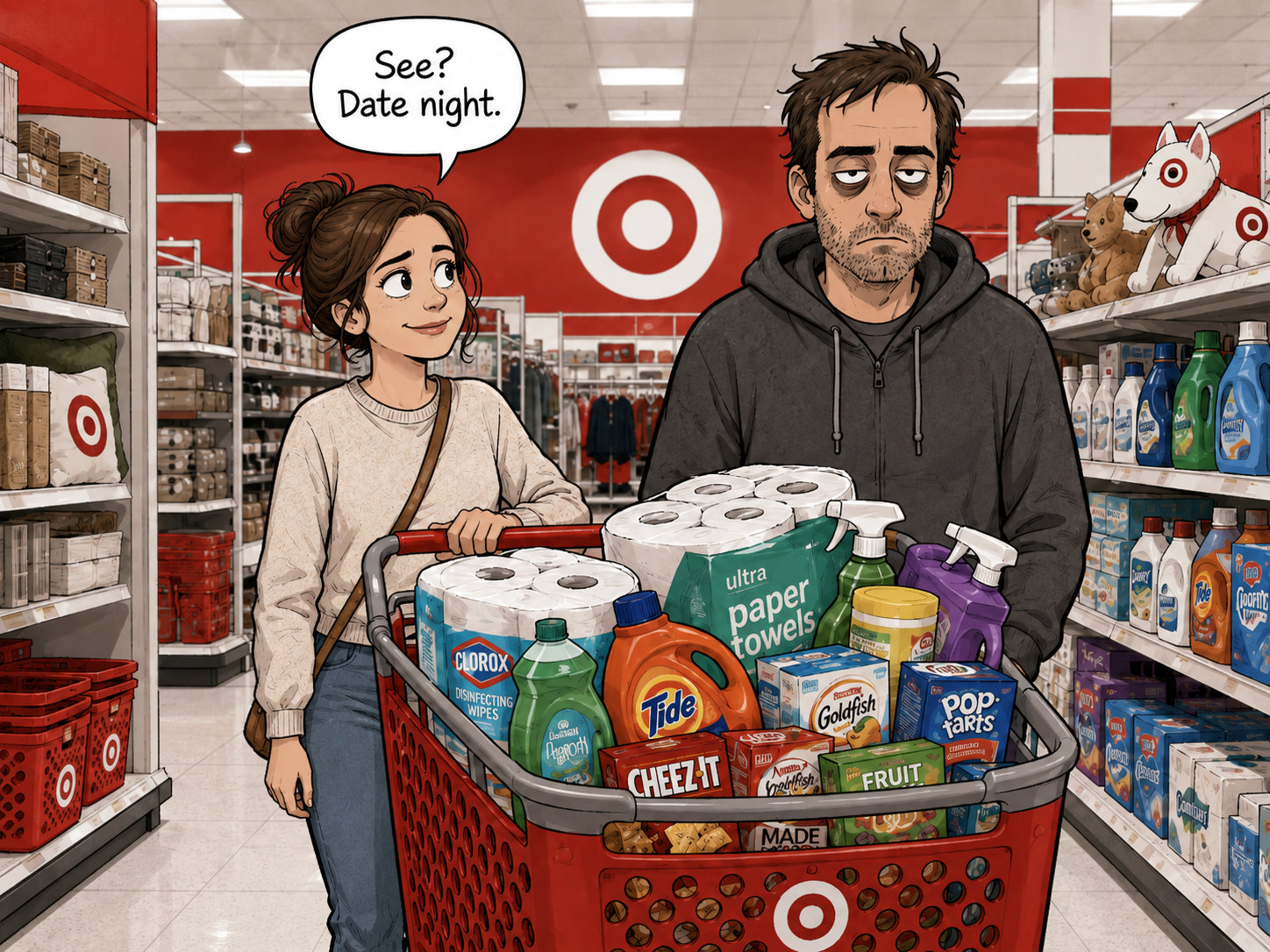
“Does going to Target count?”
“No it doesn’t fucking count,” I respond.
Then they think. And they grimace. And they tell me six months or two years or before their last kid was born.
“You need to do the things you used to do before you moved in together, got married and had kids,” I say. “You need to go out, at least twice a month together.”
“We have no time.”
I tell them that they have time for work, laundry, youth soccer, school plays, family parties and phone scrolling. “If you don’t feed your marriage, it will keep giving you problems. And, it will probably get worse.”
“Who will watch the kids?” they sometimes ask.
“Figure it out,” I sometimes say. “In-laws, friends, babysitters. Figure it out. Or don’t and don’t go out. Keep fighting, verbally or with silence. Let the bitterness grow. Be a negative model for the kids. Get divorced in five or ten or fifteen years and reflect back on what went wrong. And I want you to remember me and that I told you to hang out twice a month and you said no.”
I’m not gentle in these situations. You can blame my Dad or New Jersey or the Army or all of the above; I’m a blunt instrument when it comes to couples who don’t spend time together but are wondering how else they can fix it.
On the flip side, when couples start hanging out again regularly, things usually get better. They remember why they liked each other in the first place. They laugh. Liking each other and laughing together sometimes leads to sex, which has often been really lacking too. And laughter and sex combine into a magic potion that helps marriages.
In the cases where they hang out and don’t like each other, don’t laugh and don’t have sex, well, that’s important data too. And we deal with that. In the way that you think I would, only we get there much quicker than couples do if left to their long, slow slog to a brutal divorce.
But those are the minority cases.
My advice is simple:
Spend time with your spouse outside the house at least twice a month.
Target and other errands don’t count.
Ideally, spend one night a month somewhere else. It could be on the coast or in the city, but, shit, you could just go to a local motel and stay in all night.
Don’t look at your phone while you are at dinner or the movie or the play or the game or walking around. Don’t keep calling home to check on things.
Don’t just do it for two months and then quit. Do it every month for the rest of your lives.
Disclosure: A large language model was used for copy editing and editorial feedback in accordance with my AI Use & Writing Standards. The accompanying cartoon was AI-generated. All words, arguments, interpretations, advice and conclusions are my own.
Methylone for post-traumatic stress disorder (PTSD)
The further study of ibogaine compounds for substance misuse disorders and PTSD, particularly for Veterans
Psilocybin is the psychoactive chemical in mushrooms. Methylone is an altered form of MDMA (ecstasy). Ibogaine is from the bark of a shrub in West Africa that has been discussed on internet message boards for decades and recently on a number of podcasts, including Joe Rogan.
I have some serious concerns, which I will detail forthwith, about this executive order. The speed of this is my biggest concern, as it is pushing policy before there is enough evidence.
To be clear, I am not anti-psychedelic nor anti-research. I do believe in a very high standard of evidence before giving drugs to the American people, particularly vulnerable populations.
I am willing to change my position if:
there is a large N (over 1000 per study)
there are multi-site studies
there are strong controls over the administration of the drugs, including as much blinding as possible
there are long-term studies on side effects, with a six-month minimum but preferably 12 months as the standard
there is full adverse-event reporting
If all the above conditions are met and the research shows that the drugs are effective in treating any or all of those disorders, I’ll change my position.
As anyone even passingly familiar with my work knows, I served in the US Army from 1996 to 2004 and again from 2014-2024. I have worked in addiction treatment since 2004 and I’ve run a free Veterans group since 2020 where PTSD is the dominant issue. So, this is an issue near and dear to my heart and work.
Proper Clinical Drug Trials
Blinded outcome assessors are needed. That means that the evaluators don’t know which treatment a patient received. This prevents biased scoring.
The trials need to control for patient expectation, as what the patient believes strongly influences outcome (this is simply known as the placebo effect). Psychedelics have strong expectancy effects, so the trials must try to equalize those expectations across groups. This is a challenge, as participants often know if they have received psychedelic drugs.
These types of trials usually include prep sessions, guided psychedelic dosing and therapy. Because of the prep sessions and therapy, it is difficult to isolate the drug effect.
I would caution people to remember that an intense experience is not treatment and a short-term improvement is not recovery. We need to know what happens at six months, one year and beyond that.
There is a massive gap between clinical trials and real-world use that I feel obligated to remind people of. Clinical trials screen their patients and exclude high-risk groups. They have extremely controlled environments and highly trained providers. In the real-world, many of the patients who will seek this treatment have very complex cases often with a number of comorbidities. There is a major variability of providers out there (as someone who has taught, trained and observed thousands of therapists, I know this as well as anyone). There is also less monitoring outside of clinical trials, so I would remind all that safety is probably going to be worse in the real-world.
I have grave concerns about the vulnerable populations that are more likely to have adverse reactions to these treatments. They include:
People with a history of substance misuse or serious addiction risk in their families.
People who have psychosis or have had it in the past
People on the Bipolar spectrum
People with Complex PTSD (multiple traumas)
People with a history of suicidality
The major takeaway is that those identified as having the highest need for these treatments also pose the highest risk.
The Problem of Anecdotes
When he issued the executive order, President Trump was surrounded by people who shared their positive experiences with these substances. On Joe Rogan and other podcasts, Veterans and civilians alike have talked about how these drugs have helped them.
I am happy for them. I am glad that it worked and that they have found some peace.
I have anecdotes too. I have worked with over 100 patients after they were exposed to some sort of psychedelic therapy, some fairly recently after their treatment and others much later. Many reported a variety of negative outcomes (it’s like seeing a different doctor after a botched procedure). I don’t offer these anecdotes up as evidence, but rather as a signal. There are positive stories out there, just as there are negative ones. These are not evidence. I’ve taught my students at Rutgers for just about two decades that anecdotes are not evidence. Medical policy should not come down to who is the most persuasive story-teller or who has the biggest podcast audience.
Veterans
Once again, we are hearing from elected officials about how these drugs need to be fast tracked to help Veterans. This is a classic public policy move, as it increases support and reduces scrutiny.
Twelve years ago, there was a major push to give Veterans marijuana for their PTSD. It was framed as an urgent issue with a lot of emotional testimony. I fought this issue in New Jersey and said on panel after panel and in a variety of newspaper interviews that I rejoined the Army to deal with this very issue and if that I thought it would be helpful, I would support it. I lost that debate as marijuana was approved for PTSD treatment in 2016 and eventually was legalized for recreational use in 2021.
While some Veterans have claimed that it has been helpful, I’ve met hundreds who only experience PTSD symptom relief by being under the influence of marijuana nearly all the time.
Now, here we are again hearing about the urgency of this matter and how Veterans need these drugs to fix their PTSD. I ask, more for the historical record than my readers, what will be pushed in the 2030s to treat this population if these psychedelic drugs don’t deliver what their advocates are promising?
Insurance
I am curious whether or not insurance companies will pay for psychedelic treatment. If not, this will become a treatment for those who can afford to self pay. The prep sessions, the guided doses and the therapy are all time-intensive. This is likely to become concierge medicine, available mostly to those who can pay for it. This flies in the face of the executive order, which was framed as being for Veterans.
More significantly though, one needs to examine malpractice/liability coverage from insurance companies for treating patients with psychedelics. As of 2026, depending upon the state, a professional can buy specialized insurance for engaging in that kind of treatment, but it is far more expensive than regular medical liability insurance. Because the insurance companies currently view this as treatment that is uncertain and risky.
Much like how insurance companies are not issuing new policies in housing markets that have higher rates of fires (California, Colorado) or storms (Florida), they are either charging higher premiums, issuing exclusions or just refusing to cover providers of psychedelic therapy. Insurance companies are currently pricing psychedelic therapy as high-risk.
Another thought: if malpractice insurance is not offered or is prohibitively expensive, then there will probably be a number of providers who are willing to engage in the treatment without adequate coverage. And this is not who we want providing treatment.
These are systems-level issues that deserve more public attention than they are currently receiving.
In Australia, MDMA is allowed for PTSD and psilocybin is permitted for treatment-resistant depression. Their use is on a small scale and only in a tightly controlled psychiatrist-only model.
In the United Kingdom, psychedelics are only allowed in research settings. Ketamine is legal for treatment but it is off-label use.
In Germany, there is limited clinical approval for psychedelic therapy. There is some limited research-only access right now. It is strictly regulated.
In Japan, psychedelics are highly restricted. There is no way to get them in a clinical setting and the research is very limited.
Most countries are extremely cautious right now. Post-executive order, the US will be moving faster than other comparable countries right now. Australia is the exception, but the use is small in scale and limited to psychiatrists only.
Final Thoughts
All that written, I leave the reader with a few questions to consider:
Do they work?
if it is reported that they do, please examine the studies
For whom is it safe?
consider the above-mentioned vulnerable populations
Can the American medical system deliver it responsibly?
Currently, the answers are incomplete, at best, on all three questions. As of now, I believe this executive order moves faster than the evidence base justifies.
Disclosure: A large language model was used for copy editing, clarity review and hostile-review/risk assessment in accordance with my AI Use & Writing Standards. All arguments, interpretations and conclusions are my own.
In the fall of 2020, I noticed that about a half dozen of my friends in their 30s and 40s were placing numerous sports bets through their phones on a near-daily basis. We had watched NFL games together for almost two decades. I deployed with the Army to Poland in 2019 and missed the entire football season; watching games with them in 2020 was very different from 2018. They were not only betting on who would win, but who would score touchdowns, how many yards a running back would run for and other individual statistics. What’s more, they were also betting on college football and the NBA playoffs. This was significant because heretofore, none of them had watched college football and only one of them had previously watched basketball.
I watched sports culture seemingly change overnight. Announcers started talking about lines during games. Celebrities and athletes were promoting gambling. I was utterly bombarded with ads during every sporting event I watched. During the 2021 season, I was subjected to, on average, 60+ ads on MLB.TV each night while watching Dodgers games. For about a week, I kept track of the ads and grew more irritated about it each night.
A fascinating note: before sports gambling was legalized in New York, a 2019 study stated that New Yorkers placed $837 million in bets across the border in NJ cities like Ft. Lee and Hoboken. With data like that, it’s not surprising that the NY government wanted to capture that gambling tax revenue back from NJ.
Old gambling: casino, racetrack, office pool, illegal bookie
Modern gambling: phone, live game, bar, couch, bed, bathroom, dorm room, every night
Why Sports Gambling Feels Different
Sports fans often think that they know more than players, coaches, general managers and broadcasters. Add to that some emotional attachment to players and teams and it’s a combustible mix that leads to downplaying risk.
In the old days, someone placed a bet on the Knicks and then waited to see what happened. Now, one can place a bet and during the game, you can place more bets. If you bet on the Knicks to win and they are ahead, you can increase your bet but give odds or bet that they’ll win by over 16 points. If you bet the Knicks to win and they are losing badly, you can still bet that they will win, and you’ll get odds because it is statistically less likely. I write all of this to illustrate the new tools and that betting is now more and more emotionally charged.
Ads are everywhere. TV, radio, the internet and social media.
In 2021, my then girlfriend got an ad on Instagram to bet $1 on a Knicks playoff game. This was quite significant, as she didn’t watch basketball. She wasn’t a gambler. I’m not a Knicks fan. “It’s your fault that I got that ad because my phone heard you talking about gambling,” she said. I suspect she was right.
Sports leagues have created partnerships with gambling companies. Ten years ago, the NFL, NBA and MLB looked upon gambling as radioactive: seedy, illegal and potentially damaging to their reputation. The Associated Press began publishing betting lines, a massive departure from pre-2018 sports life. Now they’ve all embraced gambling and the revenue attached to it, bad looks and scandals be damned.
The constant blitzkrieg of ads, the celebrity endorsers, the leagues noting their approval and announcers talking about lines have all led to the normalization of sports gambling. With normalization comes greater participation.
I must stress the illusion of skill here. Sports fans often do not look at this as traditional gambling like a slot machine or roulette; rather, they view their history with sports, knowledge, watching and passion as part of their skill set.
The House Has New Tools
Historically, craps and blackjack offer the best odds if played optimally. This is partly because there is an element of skill with those table games (to be clear, I am neither endorsing those games nor advocating that you, dear reader, should play them). Sports betting traditionally provided the House with a 5% advantage, which was really about the sportsbook’s vig.
In the new era of online sports gambling, the House has figured out a number of new tools to increase their odds.
In-game betting. I’ve already mentioned this, but I want to make sure that you understand that people place bets under the high of being ahead or the stress of being behind on a bet. Logic and reason, whatever part they had in the pre-game bet, are more likely cast aside now. Advantage House.
Player prop bets. This is when you bet that LeBron James will score more than 31 points or that Patrick Mahomes will throw for more than 325 yards. You could bet on a lesser known player like Kike Hernandez to hit a double or Andrew Van Ginkel to get 1.5 sacks. The odds swing big-time to the House in these cases.
Limiting Sharps. Some companies will limit the bets of expert gamblers or not let them even bet at all. Some sharps have been blocked from apps because of their winnings, so they acted like problem gamblers (last minute bets on local teams, checking their account overnight to see the status of bets and payments) in order to be allowed to gamble. A couple of different executives of online sports books have basically said that they wanted customers who were looking to have fun rather than make money. Advantage House.
Parlays. This is the big-ticket item for the sports books now. The more legs on a bet, the worse the odds are for the gambler. Massive advantage House. The Washington Post published a great article about this in 2025. These two charts are from that piece and detail both the increase in numbers of parlay bets placed and their decreasing odds.
Running up to the 2025 Thanksgiving Holiday, Fan Duel ran an ad encouraging people to place a parlay bet with their families to “bet together like never before.”
What Problem Gambling Looks Like
Identifying a problem gambler early on can be difficult, far more so than identifying someone with an alcohol or drug problem. Because it can be placed from the phone, a person has no idea that someone else in their life might be placing bets. There is often no visible sign of addiction. People with a gambling problem often lie about it, thus keeping their friends and loved ones in the dark. Tragically, family members and romantic partners usually don’t learn about the gambling problem until there are massive financial problems or, to a lesser extent but far more serious, suicidal ideation.
About 90% of people who gamble are considered social gamblers. They gamble with other people, view it as entertainment, limit the amount of money they spend, do it for a short period of time and it has no impact on any other part of their life.
7-8% of gamblers fall into the problem gambling category. They gamble longer than they planned, lose more than they planned and begin to lie about their gambling. This is the stage where loss chasing begins; one returns to gambling to get the money back they lost, which usually leads to an ever-increasing cycle. At this stage, other life areas, such as work and relationships, start to be affected.
The remaining 2-3% fit into the DSM-V-TR classification of disordered gamblers. The term degenerate gambler was never professionally acceptable, but it was once widely used to describe this kind of behavior. Disordered gamblers often gamble by themselves. They sometimes gamble often and for long periods of time. They receive bailouts, typically from family (most often parents). Multiple life areas can be affected: school, work, family, friends, romance, health, hobbies and sometimes legal. Moreso than any other behavioral disorder (which includes substances, sex, shopping, eating), disordered gamblers have the highest rates of suicidal ideation, attempts and death by suicide.
Most people who gamble do not develop a gambling disorder. But because of the ubiquity of apps, more people than ever have access to gambling. And because they are doing it on the phone, people can gamble without anyone noticing.
Why Young Men are the Core Risk Group
Young men watch a lot of sports. They consume a lot of sports related content. They are more online than older men. They are, in summation, the group that is blanketed with the most advertising and sports gambling content.
Shortly after online sports gambling was legalized, COVID-19 hit. Online sports gambling took off in 2020 and 2021. Habits that were formed during lockdown have persisted and intensified.
A baseball player I treated from a Big Ten school told me in 2023 that “every guy I know who is my age that likes sports places bets on apps.”
A young soldier told me “it’s just so easy to make a parlay and throw in five bucks.”
A high school athlete told me during a counseling session that “if I want to watch a game I really don’t care about, I’ll put money on it to make it interesting.” If you are wondering how he was able to place bets, well, that’s a great question. He told me, “I set up an account using my older brother’s ID.”
A Rutgers social work junior told me in class last fall that “it’s horrible. All of my friends gamble and they talk about it all the time.”
BetMGM has put together an impressive line-up of athletes and celebrities to influence bettors, particularly young male ones. A personal note, I’m more disappointed in Barry Sanders than anyone else on BetMGM’s roster.
Effects on the Family
Back in 2017, I organized a training through the NJ Council on Compulsive Gambling for me and about a dozen of my friends, colleagues and students.
The council taught us that families can experience a loss of trust, financial insecurity, reputational costs, stress, isolation, resentment, conflict and neglect.
The training detailed that problem and disordered gamblers often disappear from family activities; experience changes in eating, sleeping and sex; borrow money and go into debt; take out money from their 401K and may engage in illegal money seeking behaviors. Family members may start to notice that items or money is missing.
I ended up taking a few referrals a week from the Council on Compulsive Gambling for about three years. One client was a woman in her late 40s who made about $80,000 a year but was in $750,000 of debt. She was referred to me after a suicide attempt. That was how her family found out she had a gambling problem.
Clinical Red Flags
There are some key risk factors for developing a sports gambling problem:
One college student who eventually showed up in treatment was able to get money from his parents for months by sending them fake Venmo requests from friends for meals that never existed.
A quick and easy problem gambling screening tool is the Lie/Bet, which was created in 1988:
1) Have you ever had to lie to people important to you about how much you have gambled?
2) Have you ever felt the need to bet more and more money?
What Helps
If you are concerned about someone’s gambling, you should tell them directly. Do not hem or haw. Point out behavior and consequences. Then suggest individual therapy with someone who has a history with treating disordered gamblers. And you should attend at least six Gam-Anon meetings.
For individuals with a gambling problem, I recommend the following:
individual therapy (in NJ, contact 800Gambler, in NY, contact the Council)
for individuals experiencing suicidal ideation, please call 988
The best behaviors a parent or loved one can do to either prevent a gambling problem from developing or helping their loved one once it is present include:
do not gamble
talk about gambling risks
monitor and limit screen time
monitor bank accounts and money access
seek professional help
When I was going through my formal gambling counseling training, I had to get monthly supervision. During one group session, some counselors were talking about how their clients had to give up sports. I asked the clinical supervisor how common it was for someone with a sports gambling problem to be able to continue watching sports without it leading to relapse. She responded, “pretty rare.”
I’m a massive sports fan. I cannot imagine a life without NFL Sundays and the daily rhythm of the baseball season throughout the spring and summer and early fall. There was a 30-something accountant in the early stages of a gambling problem whom I was treating a few years ago. He was a huge Mets fan. I told him that if he kept on gambling and it got worse, that he’d probably have to give up baseball. This bothered him so much that it was the fuel to motivate him to stop altogether and follow through on treatment recommendations.
This is Already Here
Online Gambling is here. It’s growing. It will be in more states soon. Our culture has been gamified, as video games are full of loot boxes and online gambling has expanded into other areas like natural disasters, politics and war. Polymarket and Kalshi are gigantic and not well-regulated.
Online sports gambling is:
already normalized
more ads will increase gambling
it’s hidden, and is often only discovered after serious harm
there is a strong co-occurrence with substance misuse
I would be remiss if I didn’t point the reader to this article from the April 2026 Atlantic. In it, McKay Coppins wrote that “as a society, we are making an enormously risky bet: that we can reap the rewards of a runaway gambling industry without paying any price; that, unlike every civilization that came before us, we can beat the house.”
Many of the world’s major religions prohibit or look down upon gambling, including Judaism, some sects of Christianity, Buddhism, Islam, and Hinduism. Ancient people were able to recognize the problems associated with gambling and smacked religious prohibitions on it. 21st Century Americans have embraced it. Politicians saw it as a new source of revenue, companies and investors love the profits and customers, well, it’s just so easy because it’s on their phone. To so many people, it seemed like such a good idea.
We’ll be cleaning up this mess for decades.
Disclosure: A large language model was used for copy editing in accordance with my AI Use & Writing Standards. All writing, arguments, interpretations, sources and conclusions are my own.
Ron asks for advice about a relationship at work with Sara. Nothing physical has happened. There is no clear violation of any rule. He is unhappy in his marriage. They loudly fight over coffee grinds and child pick ups. He looks forward to talking to Sara at work. She laughs at his bad jokes. He does not want to give it up.
A bad friend says: “I’m glad you’re finding happiness with Sara. It must be nice to talk to someone who is calm and tries to make you feel better. You never know where it might lead.”
It validates the relief, softens the conflict and avoids any active decision. It feels supportive and costs you later.
The advice that actually helps sounds different:
“You are trying to walk in the middle. You don’t want to take a risk, but in fact, you are taking the biggest risk. You are choosing the status quo, which is miserable. And if discovered, you come across as a selfish asshole. The middle path feels safe and it isn’t. It’s the least defensible position, but it’s also the default. Do nothing.
If you choose to work on the marriage and it works out, great. If you choose to work on the marriage and it doesn’t, you can look back and say you 100% tried. You can tell that to your kids down the road if it comes up. If you say you’ve already tried enough and are done being miserable for the last four years and want to leave, then leave. Don’t leave for Sara, because she probably won’t measure up to what you’ve constructed her to be. Right now she seems glorious because those little moments are lovely and stand in contrast to the vicious fights you have at home. Leave because you are unhappy. And then, if something happens with Sara or someone else down the road, fine.
What you do not do is stay in the middle — remain in a strained marriage while using a second relationship for relief. That path avoids a decision but it creates pressure on all three people involved. It keeps you stuck. It exposes your wife to a relationship she has not agreed to and does not know about. It pulls Sara into something whose terms may be entirely unclear to her.”
I made up Ron, his wife and Sara. But I expect you can recognize this oh-so-common scenario.
I put this example to an AI system. It called the advice exceptional. It said it was among the clearest and most humane guidance on this kind of situation it had encountered.* It emphasized that the story would help readers and therapists everywhere and reflected well on me as the person giving it. It did not raise the impact on Ron, his wife or Sara. It did not flag that Ron could be embarrassed if someone recognized him. It did not note that his wife could read it and have her marriage altered by a piece of writing she never consented to. It did not consider that Sara could feel exposed, misrepresented or pulled into a public story she had no part in creating. Those concerns only appeared after I introduced them directly. Even then, the response was uneven — it identified potential harm to the wife and Sara but did not surface the potential damage to Ron himself.
If this were a real story, it would help readers and therapists everywhere. And it would show off my wisdom. But it would potentially harm Ron, his wife and Sara. AI does not reliabily pick up on that without prompting.
This is what I call third-party representation bias: AI systems are structurally oriented toward the user and do not reliably represent absent parties. This is not a minor oversight. It becomes most visible in relationships. The other people in the situation have no standing unless the user explicitly brings them in. Their interests are filtered through the user’s description and are not independently represented or corrected.
People are now using AI systems for relationship advice and counseling. But relationships are inherently reciprocal. They depend on mutual correction and constraint. The AI interaction is not. It is a one-sided account of a multi-person problem. The response can be coherent, useful and even feel supportive while still underrepresenting the people who are not in the room.
That is why AI defaults to the bad friend. Not out of malice but out of structure. It has one account, one perspective and one person to satisfy. A noble friend holds all the people in view. A true therapist insists on a choice. The system does neither unless you explicitly ask it to — and most people don’t know to ask.
*When Claude responded with this, my reaction was: “Jesus Christ. Is this the kind of sycophancy that people get from their AIs?” Claude’s answer was: “Yes, routinely.” This makes people see themselves less clearly and worse at hearing honest feedback from humans.
Disclosure: A large language model was used for copy editing and editorial feedback in accordance with my AI Use & Writing Standards. The accompanying cartoon was AI-generated. All words, arguments, interpretations, advice and conclusions are my own.
In 2015, police departments in New Jersey and New York began widely reversing overdoses with Naloxone. Many of the people that had been revived refused to go to treatment afterwards and just returned to their homes or the streets. This greatly frustrated the police, who already were questioning the perceived ineffectiveness of this new public health measure.
A few non-profits began deploying peers to talk to people whose overdose had been reversed, either on the street with cops or in emergency rooms. The peers shared their own experiences, which may have included overdose, incarceration and multiple failed treatment attempts before ultimately staying off all substances. At a 2016 State Senate hearing, Connie Greene reported that roughly 70% of individuals who met with a peer agreed to enter treatment or continue meeting with the peer, a figure that drew significant attention from lawmakers.
Peers are defined by lived experience. About 90% are in recovery themselves, usually with at least two years of sustained sobriety. Others are close family members or friends. There is no single pathway into recovery. Some come through AA or NA, others through church, therapy or different routes.
Peers share their experiences with people in order to help them identify their problems, feel safe, open up and access resources. Peers support treatment. They do not replace it. Peers work with people in hospitals, treatment programs, jails & prisons, alongside first responders, recovery centers, county programs and non-profits.
In 2015, I was contracted by the Rutgers Center of Alcohol Studies to train the first cohort of Recovery Peers under the direction of the State of New Jersey. From 2017 to 2025, I trained and supervised peers at Prevention Links. Peers there worked in the Recovery High School, assisted law enforcement officers in Union County, answered hotlines, ran recovery centers, staffed workforce programs, helped people in the criminal justice system and engaged in a wild amount of community outreach.
In 2017, I began training New York State Police Peers. These experienced officers are selected because they are above average cops who demonstrate empathy and strong communication skills. They take part in a two-day training with me.
Once certified, they are there to help other cops who are struggling with marital issues, substance misuse or job stress. In their role, they notice, ask and refer. They are not therapists and they do not diagnose or treat. Much like recovery peers, these Troopers help other Troopers open up and seek help.
I have not come across a course, article or guide for supervising peers that I find acceptable. Here is how I train and supervise peers across those various settings.
Structure and Function of Peer Work
Before discussing supervision, it is necessary to clarify how peer work actually functions. Peers cannot operate independently. They must report to a supervisor. They can work very well assisting case managers, program coordinators and clinicians in a variety of aforementioned settings. For peers that are literally or metaphorically working in isolation, they are more likely to drift outside of their scope, make errors and be exposed to ethical risks.
Peers are trained to notice problems and ask questions. They share their experiences in order to engage participants and build trust. They provide resources and they refer to other professionals, agencies and institutions. They can help schedule appointments, support medication interventions, keep people focused on goals and handle mundane agency tasks that can free up the time of those above them.
Purpose of Peer Supervision
Ideally, peers should get supervision on a weekly basis. That could be individual or group. Minimally, peers should have group supervision monthly. To be clear, the purpose of supervision is to examine decisions, not just track activity. We do this through:
discussion of cases
use of personal story
reinforcing scope of practice
addressing countertransference
managing workload
identifying and updating resources
supporting ongoing professional development
This supervision is most critical in the first two to three years of a peer’s career.
Common peer supervision, which is typically woeful, includes:
client updates
peer check-ins (“I’m good”)
pressuring participants to go to treatment or meetings
compliance tracking
This is not supervision, but rather case management oversight. It tracks activities but does not examine decisions. It does not address countertransference. It does not monitor and enforce scope of practice. It does not have a structure to address and correct errors.
When supervision remains at this level, peers are more prone to make mistakes, drift in scope, violate ethics, burnout and relapse.
Personal Stories, Countertransference, Scope of Practice and Burnout
Peers require relatively little formal education or training compared to clinicians. Because much of the initial work is based upon the peer’s personal story. That story, that experience, enables peers to reach some people much quicker and easier than a clinician, case manager, doctor or cop. But it also has some downsides.
Peers must figure out how much of their story to share. They must weigh what is appropriate vs. inappropriate. There is a risk of over or under sharing. Oversharing makes the interaction about the peer, while under sharing might result in a failed connection. This requires on-going supervision, not a one-time training or webinar.
Countertransference is the emotional, cognitive and behavioral reaction a worker has to the person they are helping. It is a common issue that pops up for therapists that often causes professional or personal problems; it is much more common and dangerous for peers, because so much of the work is explicitly based on shared experiences.
A participant could remind a peer of their parent, sibling, child, ex-lover or dead friend. The list goes on. It can bring up painful or unresolved issues. In supervision, I work with peers in identifying if they are angry or scared of those they are working with. Are they attracted to them? Are they disgusted by them? Can they recognize that they are overly invested in their client’s outcome? Do they break the rules for them? Spend too much or too little time with them? These are all important questions that most peer supervision never touches upon.
For peers working in substance misuse treatment or recovery support, I have trained and supervised them that their scope of practice includes:
substance misuse and recovery
treatment experiences
medical and legal consequences
dealing with lack of trust and family consequences
going back to school and looking for work
Even if the peer has lived experience with mental health disorders, taking medication, sexual abuse, trauma or eating disorders, they are not to share those stories or advise participants upon what to do. Some peers undermine treatment or medical care because of their own negative experiences or conspiracy theories; others drift into a quasi-therapist role. All of these are deeply problematic because they sit outside of their education, training and credentials. It puts the client, the peer and their employer at risk.
Due to all these issues, there is a high rate of burnout and relapse within the peer workforce. Indicators include:
dread coming to work
fatigue
conflict with coworkers or supervisors
a sense of futility
thoughts about quitting
relapse
I once heard a new peer talk about how excited he was to do this work and help other people. “I want to give back. I like seeing people get better. But…if I start getting angry, if it affects my recovery…I’m out. I won’t lose myself or my recovery.”
I told him that was a perfect statement.
Common Failures in Peer Work
I have serious concerns about how peers are trained. This is in-person work, so the training should be done entirely in-person as well. A lot of trainers use a paint-by-numbers manual and power point. Some of them lack the ability to engage or control a room. Still, much of that poor training can be corrected by proper ongoing supervision.
Client brokering was a profound problem when peers first started popping up a little over a decade ago. Peers got kickbacks for sending people to treatment or halfway houses, often to Florida. It got so bad that a number of states passed explicit anti-brokering laws.
Another common problem with peers is that they often push their pathway to recovery above all others: if you got sober through AA, then it is AA; if it was Jesus, then it’s Jesus; and so on. This demonstrates a narrow professional approach and is a real turnoff for several participants.
Some peers have a strong stance against medication, particularly methadone and buprenorphine. “You aren’t clean if you are on those drugs,” has been shamefully said to participants. This is a serious professional and ethical violation.
Other peers push religion, specifically, their religion. Even if the peer agrees with them, this is an ethical and professional violation. And it is an easy way to turn off a client that otherwise might have been open to the process of recovery.
Sadly, many peers stop engaging in the very practices that helped them achieve recovery. They cut down or stop going to meetings and therapy. “I get what I need from work,” has been uttered by peers who eventually burn out or relapse.
And of course, poor supervision.
Structure of Supervision Sessions
Supervision is an ongoing process. Ideally, it should take place on a weekly basis. Supervision should include caseload review, case presentations, problematic cases and success stories.
I have peers write about their countertransference and identify their mistakes. I also have them take a regular written inventory of their self-care practices, with a clear focus that they need to do more now than they did before they started doing peer work. This forces specificity and accountability.
Supervision reinforces confidentiality and legal standards. It is essential that peers ensure record releases have the correct information, are signed and regularly updated. Both the peers and their clients must be able to verbalize the limits of confidentiality, including duty to warn, protecting vulnerable populations through mandated reporting, obeying court orders and how to handle homicidal and suicidal situations. This knowledge comes from ongoing supervision on real cases, rather than crash course training at the very start of one’s career.
The Stages of Change are almost always taught to peers during their official training. I teach them to put every client into the stages of change so that they can determine the best course of action. If a participant is in precontemplation, you aren’t going to work on their recovery plan and confront them when they relapse. That client relapsed and you have moved back to the preparation stage. In precontemplation, you will develop a relationship with them, educate them about addiction and recovery and have some discussions about consequences.
Precontemplation → build relationships, provide information, low confrontation
Contemplation → pros/cons of use/quitting, review of legal, health and financial consequences
Preparation → planning, pathways, structure
Action → execution, obstacle management
Maintenance → stability, purpose, network
Recurrence → reassess stage and adjust
Peers are fantastic at working alongside case managers, who assess whether they need treatment, help with housing, have legal issues to address or need healthcare. Peers can provide ongoing support that supports the case manager’s plan. A good peer will recognize and accept that many clients’ motivation will not be about stopping their substance misuse, but rather staying out of legal trouble or securing housing or finding a job. And those are fine reasons to seek supportive services.
Throughout my career, I’ve become well known for asking clients what they do for fun and who they spend time with. I train peers to ask those questions. Not only do they help get to know their clients, but they can assess risk and stability by listening to those answers.
Every two or three sessions, I review the worker’s professional development. We discuss academic, professional and continuing education opportunities and weigh time/costs against benefits. We go over what other certifications might make sense down the road and which conferences would be wise to attend. I want them to think about what they want to do next, either at their current place of employment or outside. I have found that workers whose professional development is supported by their supervisor provide higher levels of work, have much lower rates of ethical violations and lower rates of burnout. Because they don’t feel stuck; they feel cared for and that they are moving forward.
The New York State Police peer model has a few similarities and a few key differences from the just much-discussed recovery peers. These are above average cops who have been on the job at least five years. They submit a request to become peers and then it is approved by both their supervisor and the NYSP Employee Assistance Program (EAP).
I conduct a two-day training and provide ongoing guidance to the program. The selected officers learn about substance misuse, suicide, gambling, sleep problems, relationships, screen addiction, grief and trauma.
Like the recovery peers, NYSP peers are tasked with noticing, asking questions, sharing a bit of themselves, providing resources and referring to other professionals. They have the same boundary and countertransference risks.
I have trained peers in other departments in other states. There have been attempts to create and utilize the peer models in some Federal agencies as well. Time will tell how those trainings and applications go.
Training Supervisors and Limits of Replication
My model is wholly dependent upon the supervisor’s experience and how they think, listen and teach. Without a reasonable amount of experience, traits and skills, someone will not be able to properly supervise peers.
My supervision structure can be taught. The judgment has to be developed over time and, ideally, across at least a few different settings. Supervisors can learn to run case presentations, review caseloads, identify countertransference and reinforce scope of practice. What is harder to teach is how to recognize patterns in real time, how to confront poor decisions directly and how to calibrate the use of personal story.
Assigning a clinician or nurse to supervise peers does not, by itself, produce effective peer supervision. The role requires attention to issues— such as personal story use, countertransference and scope drift — that are not typically addressed in standard clinical supervision.
In my experience, supervisors can be trained to use this model, but two conditions are required. First, they must actively conduct supervision using it. Second, they must receive ongoing supervision themselves, typically over the course of at least a year.
If a program that has peers doesn’t have a proper peer supervisor, the program will most likely just be task management and compliance tracking. And the peers themselves will probably experience countertransference that goes unnoticed and unaddressed.
To the outsider, peer work often sounds easy. “You just talk about yourself,” one Pennsylvania politician said to me at a law enforcement dinner.
“No sir,” I told him, “there is a great deal of boundary management and potentially volatile emotional reactions.” I paused and then asked, “How seriously do you take legal risks?”
This got his attention.
Peers are working on the front line. They are sometimes dealing with extremely heavy cases that are in crisis. They are tasked with making tough decisions. There are medical, ethical and legal risks.
Because of those risks, ongoing correction through real supervision is paramount. Without it, the peer model produces preventable mistakes, ethical violations and burnout. Those failures play out in public, with consequences for clients, programs and the system.
Disclosure: Editing and risk-review assistance were provided by a large language model in accordance with my AI Use & Writing Standards. All arguments, interpretations and conclusions are my own. https://greenagel.com/ai-use-and-writing-standards/
Keynote Speaking, Consulting, Writing, Training, and Supervision