Psychedelics, Veterans and the Evidence Gap

On April 18, 2026, President Trump issued an executive order to “accelerate medical treatments for serious mental illness.” It addresses fastracking four issues:

  • Psilocybin for treatment-resistant depression
  • Psilocybin for major depressive disorder
  • Methylone for post-traumatic stress disorder (PTSD)
  • The further study of ibogaine compounds for substance misuse disorders and PTSD, particularly for Veterans

Psilocybin is the psychoactive chemical in mushrooms. Methylone is an altered form of MDMA (ecstasy). Ibogaine is from the bark of a shrub in West Africa that has been discussed on internet message boards for decades and recently on a number of podcasts, including Joe Rogan.

I have some serious concerns, which I will detail forthwith, about this executive order. The speed of this is my biggest concern, as it is pushing policy before there is enough evidence.

To be clear, I am not anti-psychedelic nor anti-research. I do believe in a very high standard of evidence before giving drugs to the American people, particularly vulnerable populations.

I am willing to change my position if:

  • there is a large N (over 1000 per study)
  • there are multi-site studies
  • there are strong controls over the administration of the drugs, including as much blinding as possible
  • there are long-term studies on side effects, with a six-month minimum but preferably 12 months as the standard
  • there is full adverse-event reporting

If all the above conditions are met and the research shows that the drugs are effective in treating any or all of those disorders, I’ll change my position.

As anyone even passingly familiar with my work knows, I served in the US Army from 1996 to 2004 and again from 2014-2024. I have worked in addiction treatment since 2004 and I’ve run a free Veterans group since 2020 where PTSD is the dominant issue. So, this is an issue near and dear to my heart and work.

Proper Clinical Drug Trials

Blinded outcome assessors are needed. That means that the evaluators don’t know which treatment a patient received. This prevents biased scoring.

The trials need to control for patient expectation, as what the patient believes strongly influences outcome (this is simply known as the placebo effect). Psychedelics have strong expectancy effects, so the trials must try to equalize those expectations across groups. This is a challenge, as participants often know if they have received psychedelic drugs.

These types of trials usually include prep sessions, guided psychedelic dosing and therapy. Because of the prep sessions and therapy, it is difficult to isolate the drug effect.

I would caution people to remember that an intense experience is not treatment and a short-term improvement is not recovery. We need to know what happens at six months, one year and beyond that.

There is a massive gap between clinical trials and real-world use that I feel obligated to remind people of. Clinical trials screen their patients and exclude high-risk groups. They have extremely controlled environments and highly trained providers. In the real-world, many of the patients who will seek this treatment have very complex cases often with a number of comorbidities. There is a major variability of providers out there (as someone who has taught, trained and observed thousands of therapists, I know this as well as anyone). There is also less monitoring outside of clinical trials, so I would remind all that safety is probably going to be worse in the real-world.

I have grave concerns about the vulnerable populations that are more likely to have adverse reactions to these treatments. They include:

  • People with a history of substance misuse or serious addiction risk in their families.
  • People who have psychosis or have had it in the past
  • People on the Bipolar spectrum
  • People with Complex PTSD (multiple traumas)
  • People with a history of suicidality

The major takeaway is that those identified as having the highest need for these treatments also pose the highest risk.

The Problem of Anecdotes

When he issued the executive order, President Trump was surrounded by people who shared their positive experiences with these substances. On Joe Rogan and other podcasts, Veterans and civilians alike have talked about how these drugs have helped them.

I am happy for them. I am glad that it worked and that they have found some peace.

I have anecdotes too. I have worked with over 100 patients after they were exposed to some sort of psychedelic therapy, some fairly recently after their treatment and others much later. Many reported a variety of negative outcomes (it’s like seeing a different doctor after a botched procedure). I don’t offer these anecdotes up as evidence, but rather as a signal. There are positive stories out there, just as there are negative ones. These are not evidence. I’ve taught my students at Rutgers for just about two decades that anecdotes are not evidence. Medical policy should not come down to who is the most persuasive story-teller or who has the biggest podcast audience.

Veterans

Once again, we are hearing from elected officials about how these drugs need to be fast tracked to help Veterans. This is a classic public policy move, as it increases support and reduces scrutiny.

Twelve years ago, there was a major push to give Veterans marijuana for their PTSD. It was framed as an urgent issue with a lot of emotional testimony. I fought this issue in New Jersey and said on panel after panel and in a variety of newspaper interviews that I rejoined the Army to deal with this very issue and if that I thought it would be helpful, I would support it. I lost that debate as marijuana was approved for PTSD treatment in 2016 and eventually was legalized for recreational use in 2021.

While some Veterans have claimed that it has been helpful, I’ve met hundreds who only experience PTSD symptom relief by being under the influence of marijuana nearly all the time.

Now, here we are again hearing about the urgency of this matter and how Veterans need these drugs to fix their PTSD. I ask, more for the historical record than my readers, what will be pushed in the 2030s to treat this population if these psychedelic drugs don’t deliver what their advocates are promising?

Insurance

I am curious whether or not insurance companies will pay for psychedelic treatment. If not, this will become a treatment for those who can afford to self pay. The prep sessions, the guided doses and the therapy are all time-intensive. This is likely to become concierge medicine, available mostly to those who can pay for it. This flies in the face of the executive order, which was framed as being for Veterans.

More significantly though, one needs to examine malpractice/liability coverage from insurance companies for treating patients with psychedelics. As of 2026, depending upon the state, a professional can buy specialized insurance for engaging in that kind of treatment, but it is far more expensive than regular medical liability insurance. Because the insurance companies currently view this as treatment that is uncertain and risky.

Much like how insurance companies are not issuing new policies in housing markets that have higher rates of fires (California, Colorado) or storms (Florida), they are either charging higher premiums, issuing exclusions or just refusing to cover providers of psychedelic therapy. Insurance companies are currently pricing psychedelic therapy as high-risk.

Another thought: if malpractice insurance is not offered or is prohibitively expensive, then there will probably be a number of providers who are willing to engage in the treatment without adequate coverage. And this is not who we want providing treatment.

These are systems-level issues that deserve more public attention than they are currently receiving.

International Context

Part of my training in public policy requires me to look at what other states and countries are doing.

In Australia, MDMA is allowed for PTSD and psilocybin is permitted for treatment-resistant depression. Their use is on a small scale and only in a tightly controlled psychiatrist-only model.

In the United Kingdom, psychedelics are only allowed in research settings. Ketamine is legal for treatment but it is off-label use.

In Germany, there is limited clinical approval for psychedelic therapy. There is some limited research-only access right now. It is strictly regulated.

In Japan, psychedelics are highly restricted. There is no way to get them in a clinical setting and the research is very limited.

Most countries are extremely cautious right now. Post-executive order, the US will be moving faster than other comparable countries right now. Australia is the exception, but the use is small in scale and limited to psychiatrists only.

Final Thoughts

All that written, I leave the reader with a few questions to consider:

  1. Do they work?
    • if it is reported that they do, please examine the studies
  2. For whom is it safe?
    • consider the above-mentioned vulnerable populations
  3. Can the American medical system deliver it responsibly?
    • trained providers, standardized protocols, insurance participation, liability coverage

Currently, the answers are incomplete, at best, on all three questions. As of now, I believe this executive order moves faster than the evidence base justifies.


Disclosure: A large language model was used for copy editing, clarity review and hostile-review/risk assessment in accordance with my AI Use & Writing Standards. All arguments, interpretations and conclusions are my own.
Online Sports Gambling

In the fall of 2020, I noticed that about a half dozen of my friends in their 30s and 40s were placing numerous sports bets through their phones on a near-daily basis. We had watched NFL games together for almost two decades. I deployed with the Army to Poland in 2019 and missed the entire football season; watching games with them in 2020 was very different from 2018. They were not only betting on who would win, but who would score touchdowns, how many yards a running back would run for and other individual statistics. What’s more, they were also betting on college football and the NBA playoffs. This was significant because heretofore, none of them had watched college football and only one of them had previously watched basketball.

I watched sports culture seemingly change overnight. Announcers started talking about lines during games. Celebrities and athletes were promoting gambling. I was utterly bombarded with ads during every sporting event I watched. During the 2021 season, I was subjected to, on average, 60+ ads on MLB.TV each night while watching Dodgers games. For about a week, I kept track of the ads and grew more irritated about it each night.

What Changed

In 2018, the Supreme Court ruled that sports gambling could expand outside of Las Vegas. New Jersey and West Virginia were the only states that legalized online sports betting in 2018. Pennsylvania followed in 2019; Colorado, Illinois and Washington DC in 2020. New York in 2022 and Florida in 2023. As of now, 30 states plus Washington DC allow online sports betting. Gambling companies were disappointed when California voters rejected online sports gambling in 2022. They remain hopeful to open up the Texas market in the future.

A fascinating note: before sports gambling was legalized in New York, a 2019 study stated that New Yorkers placed $837 million in bets across the border in NJ cities like Ft. Lee and Hoboken. With data like that, it’s not surprising that the NY government wanted to capture that gambling tax revenue back from NJ.

Most sports gambling takes place online. This is a massive change from pre-2018.

Old gambling: casino, racetrack, office pool, illegal bookie

Modern gambling: phone, live game, bar, couch, bed, bathroom, dorm room, every night

Why Sports Gambling Feels Different

Sports fans often think that they know more than players, coaches, general managers and broadcasters. Add to that some emotional attachment to players and teams and it’s a combustible mix that leads to downplaying risk.

In the old days, someone placed a bet on the Knicks and then waited to see what happened. Now, one can place a bet and during the game, you can place more bets. If you bet on the Knicks to win and they are ahead, you can increase your bet but give odds or bet that they’ll win by over 16 points. If you bet the Knicks to win and they are losing badly, you can still bet that they will win, and you’ll get odds because it is statistically less likely. I write all of this to illustrate the new tools and that betting is now more and more emotionally charged.

Ads are everywhere. TV, radio, the internet and social media.

In 2021, my then girlfriend got an ad on Instagram to bet $1 on a Knicks playoff game. This was quite significant, as she didn’t watch basketball. She wasn’t a gambler. I’m not a Knicks fan. “It’s your fault that I got that ad because my phone heard you talking about gambling,” she said. I suspect she was right.

Sports leagues have created partnerships with gambling companies. Ten years ago, the NFL, NBA and MLB looked upon gambling as radioactive: seedy, illegal and potentially damaging to their reputation. The Associated Press began publishing betting lines, a massive departure from pre-2018 sports life. Now they’ve all embraced gambling and the revenue attached to it, bad looks and scandals be damned.  

The constant blitzkrieg of ads, the celebrity endorsers, the leagues noting their approval and announcers talking about lines have all led to the normalization of sports gambling. With normalization comes greater participation.

I must stress the illusion of skill here. Sports fans often do not look at this as traditional gambling like a slot machine or roulette; rather, they view their history with sports, knowledge, watching and passion as part of their skill set.

The House Has New Tools

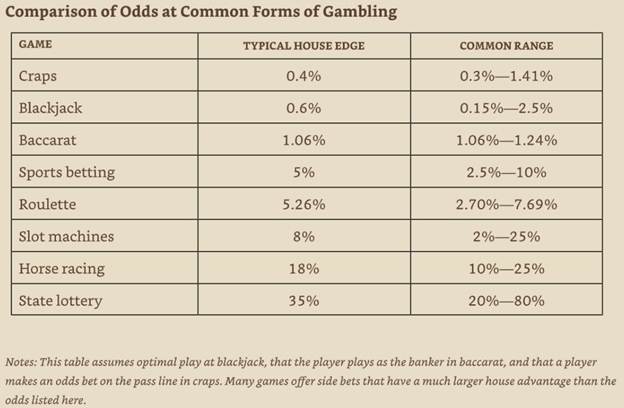
Historically, craps and blackjack offer the best odds if played optimally. This is partly because there is an element of skill with those table games (to be clear, I am neither endorsing those games nor advocating that you, dear reader, should play them). Sports betting traditionally provided the House with a 5% advantage, which was really about the sportsbook’s vig.

In the new era of online sports gambling, the House has figured out a number of new tools to increase their odds.

In-game betting. I’ve already mentioned this, but I want to make sure that you understand that people place bets under the high of being ahead or the stress of being behind on a bet. Logic and reason, whatever part they had in the pre-game bet, are more likely cast aside now. Advantage House.

Player prop bets. This is when you bet that LeBron James will score more than 31 points or that Patrick Mahomes will throw for more than 325 yards. You could bet on a lesser known player like Kike Hernandez to hit a double or Andrew Van Ginkel to get 1.5 sacks. The odds swing big-time to the House in these cases.

Limiting Sharps. Some companies will limit the bets of expert gamblers or not let them even bet at all. Some sharps have been blocked from apps because of their winnings, so they acted like problem gamblers (last minute bets on local teams, checking their account overnight to see the status of bets and payments) in order to be allowed to gamble. A couple of different executives of online sports books have basically said that they wanted customers who were looking to have fun rather than make money. Advantage House.

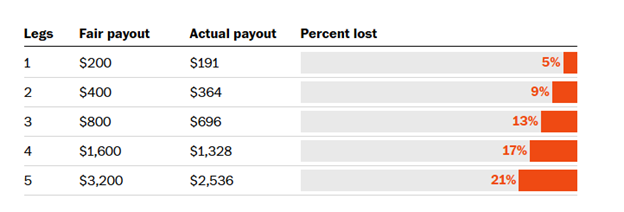
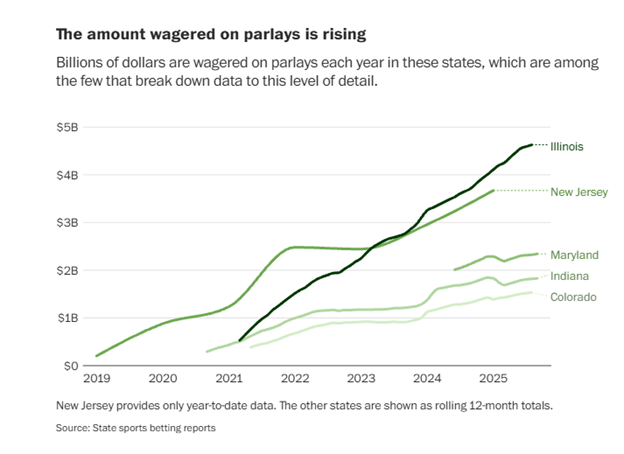
Parlays. This is the big-ticket item for the sports books now. The more legs on a bet, the worse the odds are for the gambler. Massive advantage House. The Washington Post published a great article about this in 2025.  These two charts are from that piece and detail both the increase in numbers of parlay bets placed and their decreasing odds.

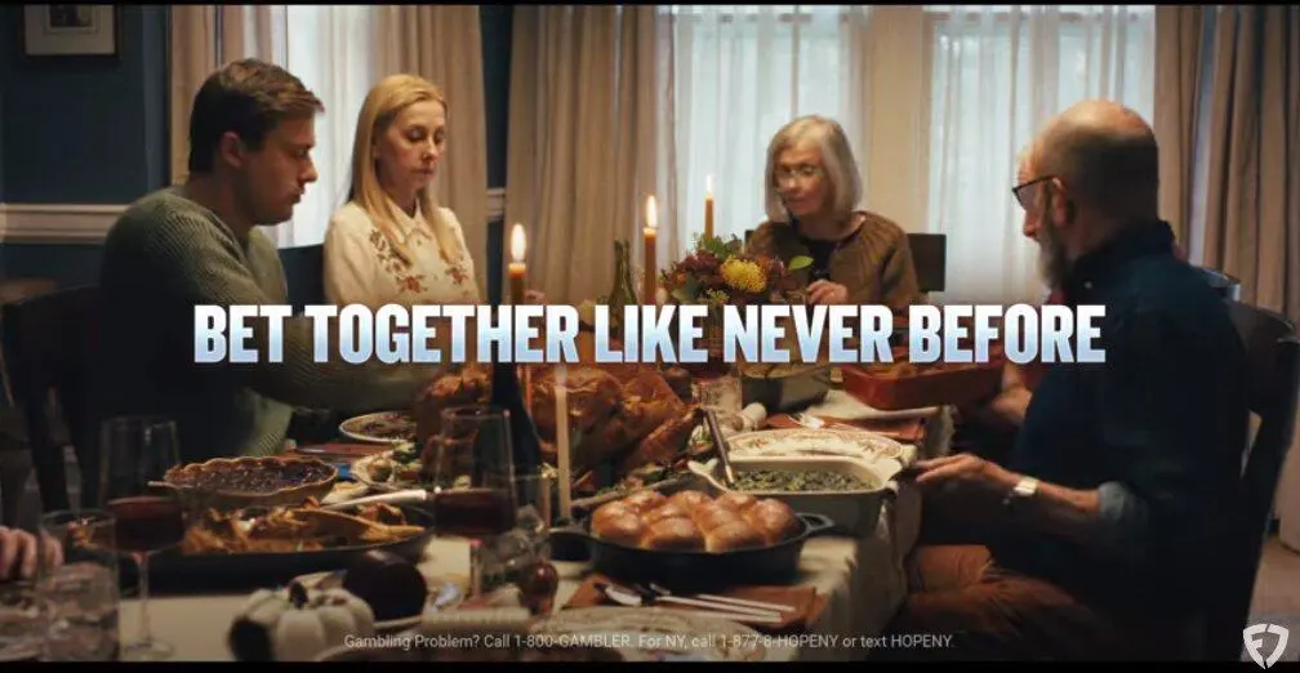
Running up to the 2025 Thanksgiving Holiday, Fan Duel ran an ad encouraging people to place a parlay bet with their families to “bet together like never before.”

What Problem Gambling Looks Like

Identifying a problem gambler early on can be difficult, far more so than identifying someone with an alcohol or drug problem. Because it can be placed from the phone, a person has no idea that someone else in their life might be placing bets. There is often no visible sign of addiction. People with a gambling problem often lie about it, thus keeping their friends and loved ones in the dark. Tragically, family members and romantic partners usually don’t learn about the gambling problem until there are massive financial problems or, to a lesser extent but far more serious, suicidal ideation.

About 90% of people who gamble are considered social gamblers. They gamble with other people, view it as entertainment, limit the amount of money they spend, do it for a short period of time and it has no impact on any other part of their life.

7-8% of gamblers fall into the problem gambling category. They gamble longer than they planned, lose more than they planned and begin to lie about their gambling. This is the stage where loss chasing begins; one returns to gambling to get the money back they lost, which usually leads to an ever-increasing cycle. At this stage, other life areas, such as work and relationships, start to be affected.

The remaining 2-3% fit into the DSM-V-TR classification of disordered gamblers. The term degenerate gambler was never professionally acceptable, but it was once widely used to describe this kind of behavior. Disordered gamblers often gamble by themselves. They sometimes gamble often and for long periods of time. They receive bailouts, typically from family (most often parents). Multiple life areas can be affected: school, work, family, friends, romance, health, hobbies and sometimes legal. Moreso than any other behavioral disorder (which includes substances, sex, shopping, eating), disordered gamblers have the highest rates of suicidal ideation, attempts and death by suicide.

Most people who gamble do not develop a gambling disorder. But because of the ubiquity of apps, more people than ever have access to gambling. And because they are doing it on the phone, people can gamble without anyone noticing.

Why Young Men are the Core Risk Group

Young men watch a lot of sports. They consume a lot of sports related content. They are more online than older men. They are, in summation, the group that is blanketed with the most advertising and sports gambling content.

A 2024 poll conducted by Fairleigh Dickinson University found that a quarter of men aged 18-30 bet on online sports and that 10% of all men in that age bracket meet the criteria for problem gambling.

Shortly after online sports gambling was legalized, COVID-19 hit. Online sports gambling took off in 2020 and 2021. Habits that were formed during lockdown have persisted and intensified.

A baseball player I treated from a Big Ten school told me in 2023 that “every guy I know who is my age that likes sports places bets on apps.”

A young soldier told me “it’s just so easy to make a parlay and throw in five bucks.”

A high school athlete told me during a counseling session that “if I want to watch a game I really don’t care about, I’ll put money on it to make it interesting.” If you are wondering how he was able to place bets, well, that’s a great question. He told me, “I set up an account using my older brother’s ID.”

A Rutgers social work junior told me in class last fall that “it’s horrible. All of my friends gamble and they talk about it all the time.”

BetMGM has put together an impressive line-up of athletes and celebrities to influence bettors, particularly young male ones. A personal note, I’m more disappointed in Barry Sanders than anyone else on BetMGM’s roster.

Effects on the Family

Back in 2017, I organized a training through the NJ Council on Compulsive Gambling for me and about a dozen of my friends, colleagues and students.

The council taught us that families can experience a loss of trust, financial insecurity, reputational costs, stress, isolation, resentment, conflict and neglect.

The training detailed that problem and disordered gamblers often disappear from family activities; experience changes in eating, sleeping and sex; borrow money and go into debt; take out money from their 401K and may engage in illegal money seeking behaviors. Family members may start to notice that items or money is missing.

I ended up taking a few referrals a week from the Council on Compulsive Gambling for about three years. One client was a woman in her late 40s who made about $80,000 a year but was in $750,000 of debt. She was referred to me after a suicide attempt. That was how her family found out she had a gambling problem.

Clinical Red Flags

There are some key risk factors for developing a sports gambling problem:

  • other gambling family members
  • early exposure to gambling
  • young
  • male
  • impulsive
  • plays sports
  • watches sports
  • listens/watches sports shows
  • has peers who gamble
  • has access to a smartphone

Some behavioral concerns for family members and professionals to be aware of:

  • borrowing money
  • hiding bank statements
  • lying about betting
  • betting during work or class
  • chasing losses
  • irritability when unable to bet
  • betting to make games interesting
  • repeated failed attempts to stop
  • homicidal or suicidal language after losses

One college student who eventually showed up in treatment was able to get money from his parents for months by sending them fake Venmo requests from friends for meals that never existed.

A quick and easy problem gambling screening tool is the Lie/Bet, which was created in 1988:

1)  Have you ever had to lie to people important to you about how much you have gambled?

2) Have you ever felt the need to bet more and more money?

What Helps

If you are concerned about someone’s gambling, you should tell them directly. Do not hem or haw. Point out behavior and consequences. Then suggest individual therapy with someone who has a history with treating disordered gamblers. And you should attend at least six Gam-Anon meetings.

For individuals with a gambling problem, I recommend the following:

  • individual therapy (in NJ, contact 800Gambler, in NY, contact the Council)
  • Gambler’s Anonymous meetings
  • delete all gambling apps from phone
  • self-exclusion
  • allow someone to monitor their bank account and occasionally check their phone for apps
  • replace gambling activities with something else
  • My Name is Craig podcast
  • for individuals experiencing suicidal ideation, please call 988

The best behaviors a parent or loved one can do to either prevent a gambling problem from developing or helping their loved one once it is present include:

  • do not gamble
  • talk about gambling risks
  • monitor and limit screen time
  • monitor bank accounts and money access
  • seek professional help

When I was going through my formal gambling counseling training, I had to get monthly supervision. During one group session, some counselors were talking about how their clients had to give up sports. I asked the clinical supervisor how common it was for someone with a sports gambling problem to be able to continue watching sports without it leading to relapse. She responded, “pretty rare.”

I’m a massive sports fan. I cannot imagine a life without NFL Sundays and the daily rhythm of the baseball season throughout the spring and summer and early fall. There was a 30-something accountant in the early stages of a gambling problem whom I was treating a few years ago. He was a huge Mets fan. I told him that if he kept on gambling and it got worse, that he’d probably have to give up baseball. This bothered him so much that it was the fuel to motivate him to stop altogether and follow through on treatment recommendations.

This is Already Here

Online Gambling is here. It’s growing. It will be in more states soon. Our culture has been gamified, as video games are full of loot boxes and online gambling has expanded into other areas like natural disasters, politics and war. Polymarket and Kalshi are gigantic and not well-regulated.

Online sports gambling is:

  • already normalized
  • more ads will increase gambling
  • it’s hidden, and is often only discovered after serious harm
  • there is a strong co-occurrence with substance misuse
  • strong links to suicidal ideation

In the states where online gambling has been legalized, independent studies have found that people have higher rates of missed credit payments, lower credit scores and higher rates of bankruptcy. This is affecting more than just the gamblers; it is causing problems for their families and society as well.

I would be remiss if I didn’t point the reader to this article from the April 2026 Atlantic. In it, McKay Coppins wrote that “as a society, we are making an enormously risky bet: that we can reap the rewards of a runaway gambling industry without paying any price; that, unlike every civilization that came before us, we can beat the house.”

Many of the world’s major religions prohibit or look down upon gambling, including Judaism, some sects of Christianity, Buddhism, Islam, and Hinduism. Ancient people were able to recognize the problems associated with gambling and smacked religious prohibitions on it. 21st Century Americans have embraced it. Politicians saw it as a new source of revenue, companies and investors love the profits and customers, well, it’s just so easy because it’s on their phone. To so many people, it seemed like such a good idea.

We’ll be cleaning up this mess for decades.


Disclosure: A large language model was used for copy editing in accordance with my AI Use & Writing Standards. All writing, arguments, interpretations, sources and conclusions are my own.

AI: The Bad Friend

Ron asks for advice about a relationship at work with Sara. Nothing physical has happened. There is no clear violation of any rule. He is unhappy in his marriage. They loudly fight over coffee grinds and child pick ups. He looks forward to talking to Sara at work. She laughs at his bad jokes. He does not want to give it up.

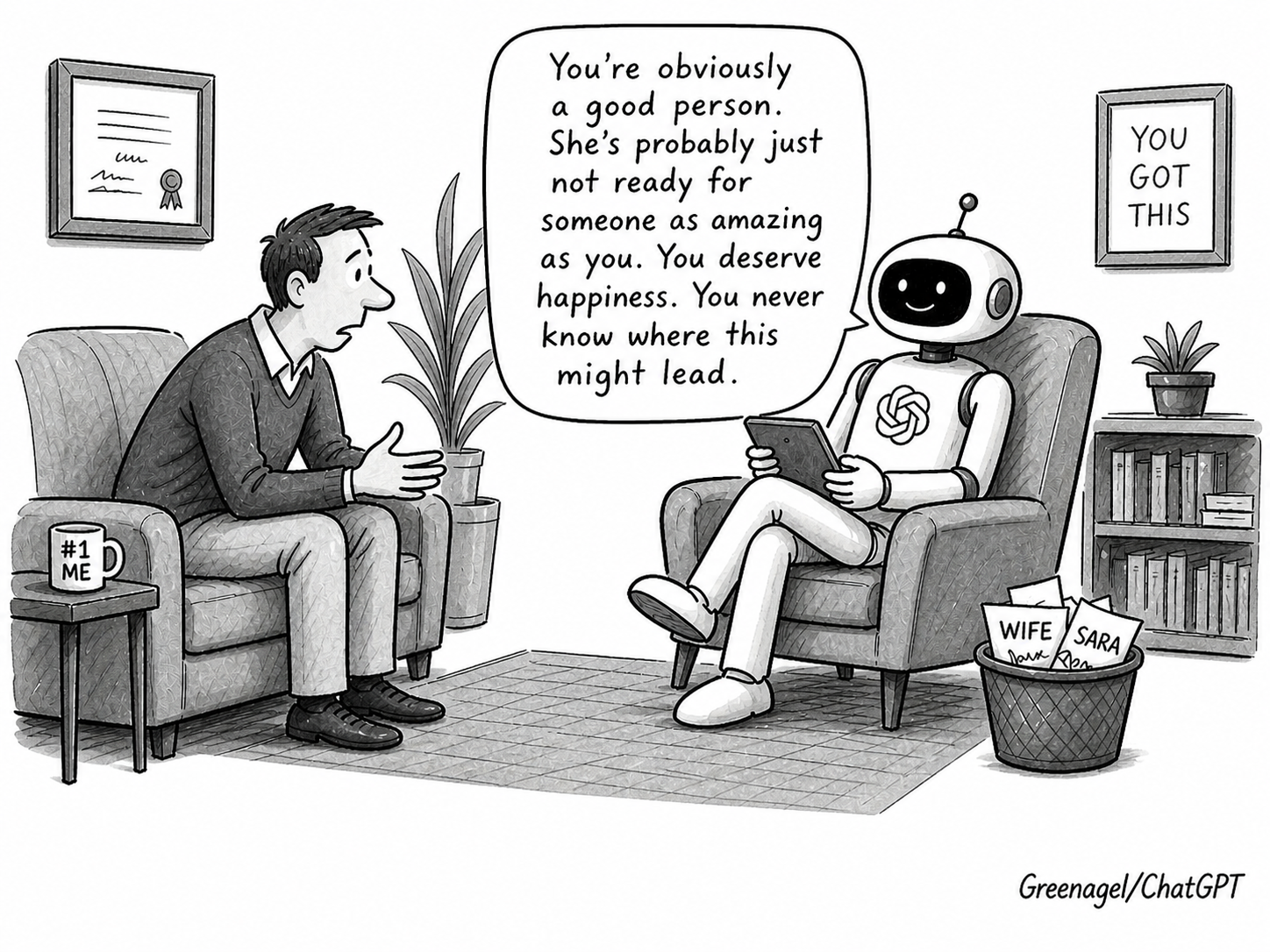
A bad friend says: “I’m glad you’re finding happiness with Sara. It must be nice to talk to someone who is calm and tries to make you feel better. You never know where it might lead.”

It validates the relief, softens the conflict and avoids any active decision. It feels supportive and costs you later.

The advice that actually helps sounds different:

“You are trying to walk in the middle. You don’t want to take a risk, but in fact, you are taking the biggest risk. You are choosing the status quo, which is miserable. And if discovered, you come across as a selfish asshole. The middle path feels safe and it isn’t. It’s the least defensible position, but it’s also the default. Do nothing.

If you choose to work on the marriage and it works out, great. If you choose to work on the marriage and it doesn’t, you can look back and say you 100% tried. You can tell that to your kids down the road if it comes up. If you say you’ve already tried enough and are done being miserable for the last four years and want to leave, then leave. Don’t leave for Sara, because she probably won’t measure up to what you’ve constructed her to be. Right now she seems glorious because those little moments are lovely and stand in contrast to the vicious fights you have at home. Leave because you are unhappy. And then, if something happens with Sara or someone else down the road, fine.

What you do not do is stay in the middle — remain in a strained marriage while using a second relationship for relief. That path avoids a decision but it creates pressure on all three people involved. It keeps you stuck. It exposes your wife to a relationship she has not agreed to and does not know about. It pulls Sara into something whose terms may be entirely unclear to her.”


I made up Ron, his wife and Sara. But I expect you can recognize this oh-so-common scenario.


I put this example to an AI system. It called the advice exceptional. It said it was among the clearest and most humane guidance on this kind of situation it had encountered.* It emphasized that the story would help readers and therapists everywhere and reflected well on me as the person giving it. It did not raise the impact on Ron, his wife or Sara. It did not flag that Ron could be embarrassed if someone recognized him. It did not note that his wife could read it and have her marriage altered by a piece of writing she never consented to. It did not consider that Sara could feel exposed, misrepresented or pulled into a public story she had no part in creating. Those concerns only appeared after I introduced them directly. Even then, the response was uneven — it identified potential harm to the wife and Sara but did not surface the potential damage to Ron himself.

If this were a real story, it would help readers and therapists everywhere. And it would show off my wisdom. But it would potentially harm Ron, his wife and Sara. AI does not reliabily pick up on that without prompting.

This is what I call third-party representation bias: AI systems are structurally oriented toward the user and do not reliably represent absent parties. This is not a minor oversight. It becomes most visible in relationships. The other people in the situation have no standing unless the user explicitly brings them in. Their interests are filtered through the user’s description and are not independently represented or corrected.

People are now using AI systems for relationship advice and counseling. But relationships are inherently reciprocal. They depend on mutual correction and constraint. The AI interaction is not. It is a one-sided account of a multi-person problem. The response can be coherent, useful and even feel supportive while still underrepresenting the people who are not in the room.

That is why AI defaults to the bad friend. Not out of malice but out of structure. It has one account, one perspective and one person to satisfy. A noble friend holds all the people in view. A true therapist insists on a choice. The system does neither unless you explicitly ask it to — and most people don’t know to ask.


*When Claude responded with this, my reaction was: “Jesus Christ. Is this the kind of sycophancy that people get from their AIs?” Claude’s answer was: “Yes, routinely.” This makes people see themselves less clearly and worse at hearing honest feedback from humans.