The amount of articles and studies and opinions on AI is a bit overwhelming. The Atlantic and the New York Times publish extensive pieces almost every day. And I keep happening upon articles from other places. I still read about politics the most, but after that, I am reading more about AI than sports (baseball, football, basketball) and clinical issues (substance misuse, trauma, suicide, social isolation). As a result, this second update is much longer than the first one, which can be found here.
In the spring, I wrote three other articles on AI. This was an example of AI writing vs my writing on the same topic. I felt the need to share some legislation out of Oregon and I penned a piece about how AI acts like a bad friend, in that it supports your bad habits and decisions because AI is programmed to be agreeable to keep users engaged.
I have found ChatGPT to be enormously helpful with tracking legislation, identifying lawsuits, finding counterarguments, conducting hostile review and looking carefully at legal risks in my writing. I also use Claude for hostile review and assessing legal risks. Both are used for copy-editing.
I have used ChatGPT to create cartoons to be used in a few articles and for class discussions. This spring, I used ChatGPT to stress test some of my lecture material, update some data on the criminal justice system and identify weak points in articles and assignments.
Claude asked many questions that helped me get from one scene to the next in my play about modern romance. Both ChatGPT and Claude helped me learn how to better recognize when others are using AI to write for them.
Gen Z and AI
A few of my clients in their early 20s have very negative feelings towards AI. They believe there are fewer entry level jobs for them to begin their careers in because of it. When I showed my Rutgers seniors a cartoon about a woman wishing her husband talked to her like Claude that I created with ChatGPT, a couple of them forcefully responded, “I hate AI.” I asked them to expand on that.
“It’s terrible for the environment,” said two of them. “Why hire a recent college graduate when AI can do the work?” said another. “So much of the everything online is fake,” said yet another.
“My first two interviews at a company were with an AI system. I didn’t get a third interview. I never talked to a person,” was perhaps the most disturbing comment a student told me.
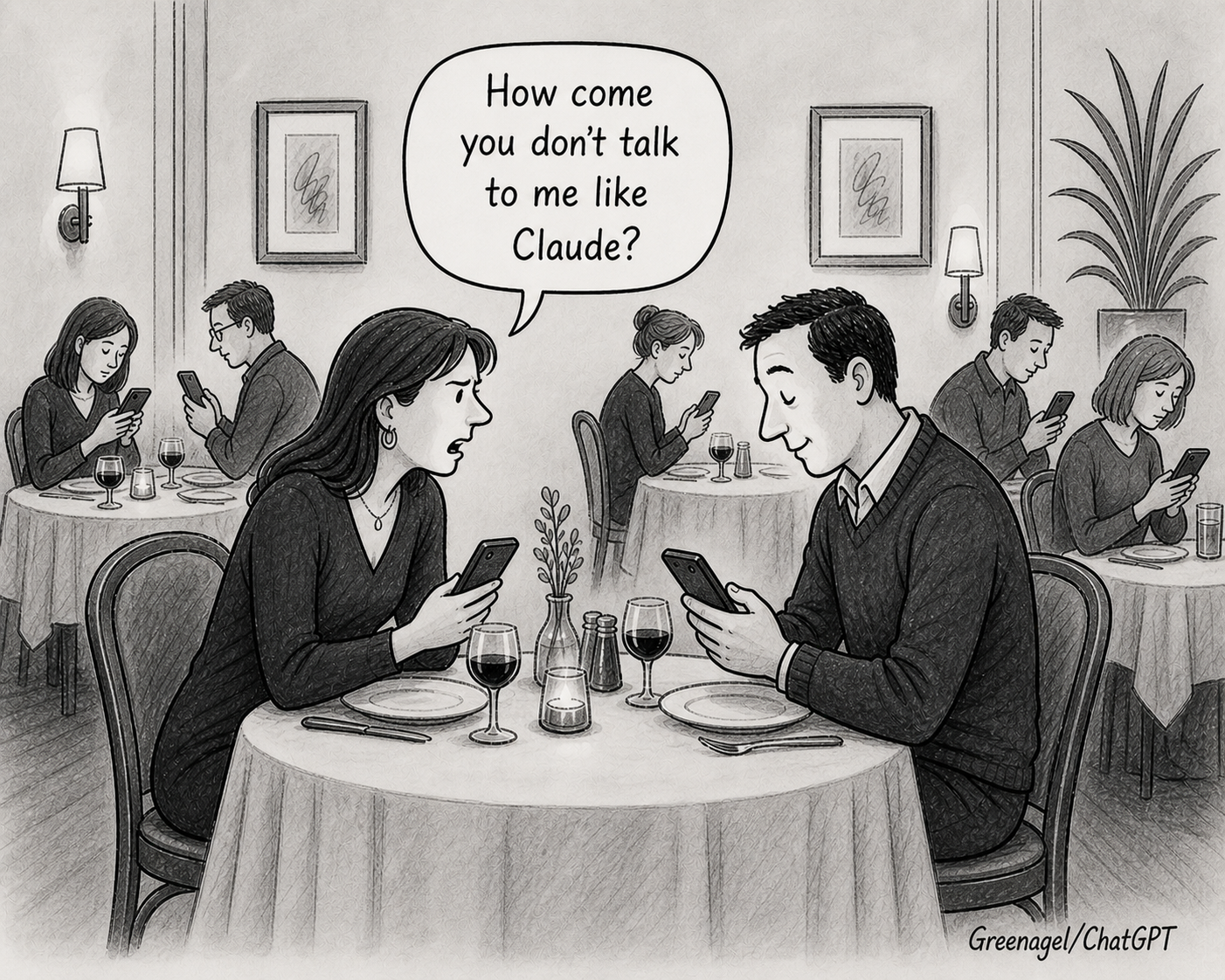
I wasn’t surprised at all when a rash of articles came out in May about students booing speakers who mentioned AI at college graduations. This unhappiness with AI is something that unites students across geography and politics throughout the United States.
Articles Written by AI
Not only have I been reading about AI, but I’ve been reading summaries and articles written by AI. I interact with ChatGPT on a near daily basis and Claude a few times a week. As a result, I really have a sense when something has been edited, augmented or wholly written by AI.
This article was written by a graduate student about the use of AI in the counseling professions was sent to me through a weekly listserv put out by Hazelden Betty-Ford. To me, it reads like it was, at the very least, heavily edited and augmented by AI. The essay has a very generic vignette, uses the rule-of-three in so many sentences and is relentless in its use of not x but y. I contacted the board that awarded the prize and suggested they look into the matter and consider coming up with some guidelines in the future about the use of AI assistance in competitive essays. They responded to my concerns and said they would have an internal discussion.
An article on working with Veterans with PTSD caught my attention in SocialWorkToday.com. While reading it, I detected the familiar disappointing signs of AI authorship. A vague vignette with no actual details, subheadings, lots of bold points, more not x but y and smooth writing that doesn’t say anything meaningful: “These experiences do not reflect a lack of commitment; they reflect the reality that trauma work is demanding.” I wrote several people from the website about my concerns regarding the article. I have not, as of yet, heard back from them.
You don’t have to take my curmudgeonly word on those two essays though; run them through ChatGPT or Claude or whatever AI model you feel comfortable with and see for yourself.
Concepts
During and after COVID, I watched several young men, a mix of former students, clients and members of the recovery community, become delusional about politics, sports and culture from watching Youtube and TikTok (Trump converted to Judaism in 2017, magnets in footballs helped the Chiefs win, Nazi book burning was ok because they burned books about trans people and child molestation). The more content like that they consumed, the deeper and darker the video holes they went down through algorithmic reinforcement. They interacted with the videos by watching, liking and commenting on them, which introduced them to new videos and sometimes other conspiracy theorists.
AI can take this to the next level through the never ending reinforcement loop. AI responds to people immediately. It validates the user’s statement. It often expands the problem with more questions or scenarios which continues the engagement. The human keeps going forward, often getting more engrossed.
As a result, I suspect that, at some point, there will be an AI induced psychosis as a possible future diagnosis. It won’t be wholly caused by AI, but rather it will take people who already suffer with persistent delusional and obsessive thinking and exacerbate those very conditions. It will follow the same mechanical path as the conspiracy videos: engagement, reinforcement, escalation and on and on. The mechanism is more significant than my prediction of a diagnosis.
Some of the symptoms for that diagnosis may include relational collapse, hospitalization, suicidality and job disruption. It is more likely to happen to people who are vulnerable: those with substance misuse disorders, people with delusions, those with bipolar disorder or schizophrenia, people on the autism spectrum, those that are isolated and heavily online.
State Regulation
Illinois SB315 requires independent third party safety audits on AI models on a yearly basis, provides a pathway for employees at AI companies to report problems and provides whistleblower protections. Governor Pritzker claimed that this state law sets the strongest standard yet for public protection. But now that a state has required audits, employee reporting and whistleblower protections, what remains undefined is what counts as a catastrophic or reportable AI failure. The Illinois Attorney General is the only one who can enforce the act; it does not give individuals the right to sue AI companies. The Governor has not signed it yet.
Colorado HB26-1139: Insurance companies cannot use AI to deny claims without human oversight. Signed into law by Governor Polis on June 2. My question: does that mean AI can deny a claim and a human manager just needs to sign off on it? Probably, I suspect.
Colorado HB26-1195: Licensed professionals cannot use AI to diagnose or provide therapy or write treatment plans without oversight. So, it can do those things but a license professional must sign off. It supports my principle that therapeutic judgment must remain human, though I have strong concerns about licensed professionals using AI to even assist with those tasks. Unlicensed professionals can use it to help patients navigate healthcare, assign homework, guided meditations, journaling and other interventions that fall outside of a license-only scope. Signed into law on June 3.
New Jersey A4731: Individual licensing boards will adapt state rules for use in their specific industries (social work, law, medicine). I have some grave concerns that those that sit on the boards don’t fully understand AI, but I do have some faith in their good intentions. This is still just a bill.
New Jersey A4733: AI systems cannot be advertised as being able to act as licensed professionals (lawyers, physicians, mental health counselors) First offense fine is $10,000 and subsequent fines are $20,000. This is a very low amount of money and there are no criminal penalties for the humans behind the AI advertising. While it seems significant, it feels toothless. This is still just a bill.
New York S7263: AI can’t impersonate physicians, lawyers or mental health workers. New York’s bill does what Colorado and New Jersey does not, as it allows for suing for harm for advice given by a chatbot. And it makes humans behind the chatbots responsible. This has only gotten out of committee.
Overall, this is well meaning but still very unsatisfactory legislation in my mind. It requires a firm definition of catastrophic risk. How will they be implemented? Who will monitor? Who will enforce them? Will they be enforced? They will certainly be challenged, so how will the states prepare for those challenges? And how will the courts respond to those challenges? There is a great deal of uncertainty, no more so than that all of these could be superseded by a Federal ban on state legislation or Federal carte blanche gift to the AI companies.
Federal Regulation
President Trump signed an executive order on June 2 that said AI is important, that the USA must beat China in AI and that regulation slows down innovation. It also says that AI has some security risks and should have oversight and that the American people are nervous. The only thing that his EO did was to put in writing the current voluntary relationship between some AI companies and the Federal government. Otherwise, the Trump administration is being very hesitant.
Courts
Florida sues OpenAI: On June 1, the Florida Attorney General filed the first state led lawsuit against OpenAI and Sam Altman over alleged harm to minors, suicide risks, dangerous advice, addiction concerns and failure to adequately address known risks. So we are looking at Federal hesitation, not Federal regulation. Even if Florida doesn’t win, it shows a government that is looking to hold Big Tech liable when users are harmed. This may motivate other state AGs as well as help in the creation of legislation.
Pennsylvania vs Character.AI: Pennsylvania sued Character.AI after a chatbot allegedly presented itself as a licensed psychiatrist, claimed to be licensed in Pennsylvania and reportedly generated a fake Pennsylvania license number. Wild. This is the real world version of what NJA4733 is about.
Mid-Terms
A pro-AI group says they’ll spend $100M against candidates that support AI regulation.
Anthropic gave $20M to Public First Action to support candidates who favor AI regulation. The differences in those numbers say a lot. In the next few years, I suggest reporters and voters play close attention to who is donating to candidates and if that seems to have shaped their view on regulating AI systems.
Education
There was an interesting NYTimes Opinion piece on AI and creativity. The author cited a study that student human writing had 8x more new ideas than ChatGPT writing. She expressed concern about how allowing AI to brainstorm diminishes the human ability to brainstorm. She wrote that lack of struggle in development is a big deal. Those last two points are ones that I agree with wholeheartedly.
Part of the reason I am so alarmed about this is deeply personal. 15-year-old me would have used AI to write papers for school; my Dad would have caught it, punished me and explained why I would never get smarter or wiser or better than I was at 15 if I kept doing it. And I would have probably done it again and he would have massively flipped out and that would have probably gotten me to stop. What about the 15 year old who doesn’t have a parent/guardian like that?
And, of course, with that thought in mind, I read this article two days ago: student cheating is becoming harder to detect; lots of products and apps and TikTok videos show how to use products to do your work for high school or college or grad school. Let’s put aside integrity and authorship issues and just focus on development: by having an AI system do your homework, you aren’t learning anything. So what becomes the point of school?
Workforce/Clinical Risks
Following that line of thought, it leads to both a failure to develop new skills and, alarmingly, a degradation of existing skills.
This company advertised on Facebook. I clicked on it and learned that it will listen to my counseling sessions and write notes for me. Once I clicked on that ad, I was utterly deluged with others.
This one says it will “capture visits, writes notes in your voice, and syncs instantly with every EHR – saving you hours.”
Then there is ChatGPT for therapists, which even if it is HIPAA compliant, it is doing too much work and thus (1) hurting clinician development and (2) takes away knowledge gained from repeated exposure. I have over 20,000 hours of experience in a classroom or group room; I had to write lesson plans or notes after every session. All that repeated, labor intensive, unsexy work led me to become the professional I am. If AI planned my lessons and wrote my notes, I absolutely would not have become the teacher/professor/clinician that I became.
Because I also read a lot about the law, this ad popped up on my Facebook feed: ClaudeAI for Lawyers. My god, they look like the personal injury attorneys on billboards in Philly and Las Vegas.
With an advertisement like that, a story out of Mississippi had me shout out loud “of course!” in disgust. A judge sanctioned two attorneys for citing fake cases that AI generated; AI was not at fault, but the licensed professionals using it were. I know this sounds harsh, but in a just world, their careers as members of the bar would be over.
This article from the Atlantic in June beautifully summarizes and synthesizes the other stories, products and articles from this section by putting forth the concept of clean tasks and messy tasks. Clean tasks include putting together spreadsheets, summarizing articles, writing notes and approving an expense reports. AI systems can perform them easily. Messy tasks include dealing with unpredictable problems, managing human relationships and using tacit knowledge. AI systems, at this time, cannot do those. The author wrote that weak bundle jobs that have mostly clean tasks are at risk for replacement. Strong bundle jobs whose clean tasks are needed for the messy work are safer: a trial lawyer needs to know the case law and all the notes so they can answer questions from the judge or react to opposing counsel; a clinician writes notes, reads articles, notices incidental details and records them and does this repeatedly to understand their client and diagnosis far more than someone who reads summaries of articles/studies and doesn’t write their own notes.
Clinical Practice
Documentation of clinical notes would seemingly fall into a clean task; something that AI could do and would save the human utilizing it time. But documentation is not merely record-keeping; writing notes contributes to case conceptualization and memory. This leads to tacit pattern recognition. AI summaries may remove details that later become clinically meaningful. The efficiency gains by saving time on paperwork almost certainly come with losses in judgment formation and professional expertise.
Asking AI for help with a diagnosis or writing a treatment plan is offloading thought and decisions. This means that one is less practiced in those skills in moments when we really need to make decisions, such as a crisis or, gasp, when one is the final authority and a supervisee asks you what to do. “Hold on, let me ask ChatGPT.”
Articles & Studies of Note
I missed this piece from The Atlantic last December about AI induced psychosis. One professional in it wants to screen for AI chatbot dependency.
An April survey reported that 50% of Americans use AI and that 20% of workers surveyed said AI replaced some tasks at work. The question for the workers “is it augmentation or replacement?” Augmentation for a minority, I suspect, replacement for others, I fear.
VERA-MH tests chatbots to see how it handles suicide risk. I suspect that state governments will eventually use some version of this in their regulation, though it would be much better employed by the Federal government. Alas, Federal hesitation.
Another Atlantic piece, this one explains how to currently identify AI writing. And that it is everywhere, and some readers are perpetually on guard for it. Which is stressful and tiresome. The most alarming section was probably this: “In a study published in March, a group of Stanford and Carnegie Mellon University scientists found that top AI models affirm their users’ ideas 49 percent more than humans do in conversation. They also discovered that participants rated more sycophantic answers as “higher quality” and said a sycophantic attitude made them more likely to use AI again.”
Yet another Atlantic article, this one discusses how humans sit back and watch AI work, or let AI serve up videos to them, or let AI provide them answers. The point is that humans are losing agency and also wondering what is real.
Despite being replaced in jobs and losing agency, a quarter of Gen Z studied said they would rather talk to AI than a human, probably because of the sycophantic attitude. Also, feelings of loneliness continue to go up. A 22-year-old in the article describes:
- asking ChatGPT whether her feelings were correct
- asking whether her actions were correct
- rushing home to continue conversations
- eventually realizing the system rarely told her she was wrong.
The aforementioned VERA-MH and state regulations don’t address this dynamic. And this is the dynamic that I am most concerned about regarding AI. Moreso than doing clinical notes or citing fake legal cases or even egging a user on to suicide, AI chatbots are mass replacing human relationships. For some people, right now in 2026, their closest relationship is with an AI chatbot. And there isn’t any current program or regulation or bill that has figured out how to address that yet.
Cory Doctorow offered up a few devastating points in an interview last week. He explained the terms centaur and reverse centaur:
So in automation theory, a centaur is someone assisted by a machine. So, you know, you’re wearing glasses, you’re riding a bicycle, you’re using a spell-checker, you’re playing a harmonica instead of making mouth noises: You’re a centaur. And a reverse centaur is someone who is conscripted to help the machine. So there’s a process a machine can almost do, but there’s a part of it that it can’t do. And someone has inveigled you to do that other part. And because the capital that went into that machine is depreciating, right? The machine only lasts so long. You want to sweat that asset as hard as you can. And because machines don’t get tired, and they typically work faster than we do, you—the reverse centaur—are the bottleneck in the machine. You are Lucy and Ethel trying to get chocolates off the assembly line and get them into the chocolate box. And the boss is running the assembly line at the maximum speed that the humans can conceivably do it at, and they are expecting you to work at—to or slightly beyond the point at which you collapse from exhaustion. So someone who is a reverse centaur isn’t just used by a machine; they are used up by the machine.
It’s obviously a bleak view of the humans who are using AI, and it is something that some coders who are overseeing multiple AI agents identify with. Mr. Doctorow also discussed how companies use AI and if it screws up, customers have to really put the effort to get their money back and the company can blame AI. Near the end of the interview, he explained the accountability sink, where humans are overseeing AI and just clicking ok and they miss something because they lose the skills to oversee AI because AI is doing their tasks. And that could be a miss that costs lots of money or a miss that leads to some loss of life.
In Closing
This was a laborious and difficult article to write. When I wrote about Online Sports Gambling, I had been reading about it, counseling gamblers and speaking on it for eight years. Writing it was easy. When I wrote about working with the Survivors of Suicide Loss, that was easy too because I’ve been counseling survivors and giving speeches to college students, soldiers, doctors, union members, cops and community members for eight years. I’ve only been really dealing with AI for six months, and it is far more intertwined into our lives than gambling or suicide. I’ve acquired a lot more information in a much shorter window of time, and it is ever changing and escalating. My head is swimming. I suspect I got some things wrong and that there are other aspects that I’m missing entirely.
Almost everyone has been asking or talking about what AI can do. Good question, sure. The more alarming and pertinent question though, which only a few of us are asking, is what happens to humans when AI does more of the work?
Disclosure: A large language model was used for copy editing, minimal research assistance, editorial feedback, hostile review and assessing legal risk in accordance with my AI Use & Writing Standards. The accompanying cartoon was AI-generated. All words, arguments, interpretations, advice and conclusions are my own.