The Greenagel Equations are a set of practical frameworks developed between 2005 and 2008 in schools, outpatient and family treatment settings. They were built in rooms, not in theory, and have been used with students, families, law enforcement, veterans and therapists.
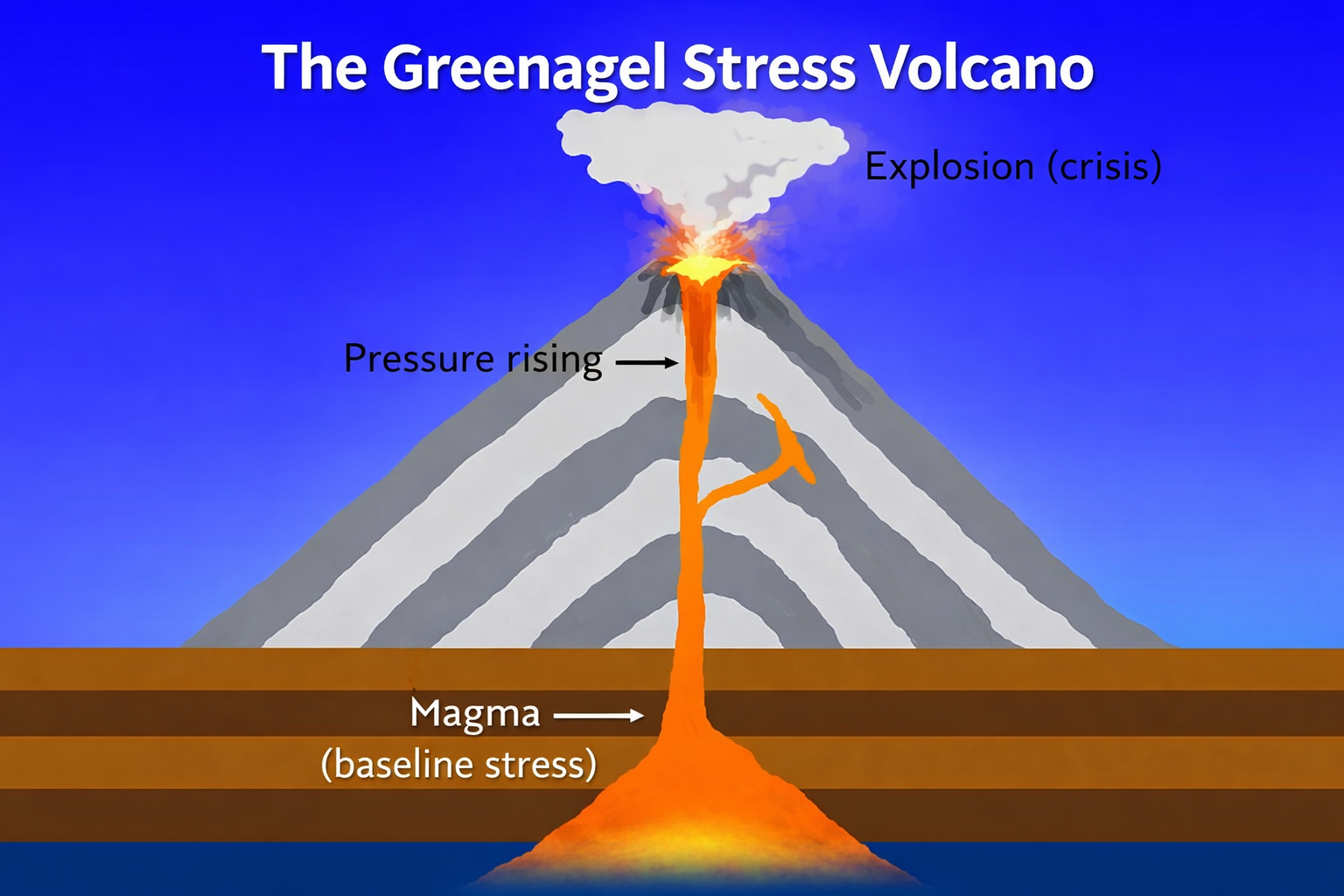
Everyone has a baseline level of stress. Your baseline depends on a few factors: childhood experiences, parental modeling, adult experiences and your stress regulating behaviors. This model explains how stress builds and when it turns into a crisis.
Stress functions like a volcano. Ideally, the magma level is one’s baseline stress. As we experience stress, the pressure rises. When we experience a crisis, it is like a volcanic explosion. Ash darkens the sky and lava runs down the sides, threatening all in its path.
Some people live near the bottom. Some live near the top. Most live somewhere in the middle. The lower one’s baseline, the greater their capacity to handle stress and emergencies without blowing up. Higher baselines mean that small triggers can lead to an explosion.
As a teenager, I lived near the top and would easily erupt over petty and inconsequential things. Entering recovery at 19 and finding a variety of calming behaviors moved my baseline to the low magma level. This has helped me survive my work.
Everyone experiences increases in stress. Movement up the volcano is normal, for both small and big things. During big Vikings or Dodgers games, my stress level goes up a little bit. The key here is baseline position, not the existence of stress.
Unlike the other equations, I don’t remember the exact moment I came up with the volcano. I know it happened in a substance misuse treatment group though. Clients would talk about how they would experience stress and act out sexually or binge eat or overspend. And while it helped them temporarily, eventually the good feeling passed and their stress level would rise again, sometimes even worse than before because of their actions. They would move down the volcano when they were high, but the next day they would rise right back up to their baseline level. Eventually, I included all of the process disorders as unhealthy ways that people try to manage their stress:
- Substances
- Gambling
- Video Games
- Screens & Social Media
- Food
- Shopping
- Sex & Pornography
Two consistent factors come into play here:
- The relief from these behaviors is temporary
- Engaging in these behaviors over a long period of time leads to an increase in the baseline.
Whenever I teach this, whether it is in group, class, trainings or individual sessions, I wait for someone to ask, “How do I permanently move down the volcano?”
I always smile and say, “I was waiting for that question.”
I tell people that these behaviors will help people slowly move down the volcano. They need to be consistently done over a long period of time:
- Therapy
- Reducing or, ideally stopping, maladaptive behaviors (drinking, gambling, overeating)
- Exercise
- Proper sleep hygiene
- Healthy eating
- Time off from work or school
- Time in nature
- Avoiding red arrow people
- Participation in sports, clubs, associations and 12-step groups
- Enjoyable hobbies
- A sense of purpose
Consistent engagement in a number of these will move someone down the stress volcano.
For people who had a rough childhood, their baseline stress as an adult will be higher. If you have been trained on or read about ACE scores, you know that a higher ACE score predicts a vast number of physical and psychological problems. That written, ACE is not destiny. Someone can have a high ACE score and still end up being pretty low on the stress volcano. But, I can assure you, they engage in several of the aforementioned positive behaviors.
For people in high stress jobs, their baseline stress will be higher. High stress jobs include but are not limited to the military, law enforcement, fire fighters, EMTs, and emergency room medical professionals. To be clear, not all military and law enforcement jobs are stressful. The highest type of stress comes from a) your own life being in danger b) protecting/rescuing other people in danger c) seeing awful things happen to kids and d) being continually responsible for a number of people.
If you are reading this and identify that you had a rough childhood and you are in a high stress job, you should be on high alert that you are at risk for living at the top of the stress volcano. You might have figured this out already though and have engaged in a bunch of those positive behaviors for years as a way of taking care of yourself.
A couple of years ago, I taught my stress volcano at a State Police Forensic Lab and I later learned that a number of the attendees weaponized it. “Your stress volcano is super high” and “you are making me move up the stress volcano” were phrases employees threw at each other.
I don’t want people doing that. This is not for you to label others or criticize them. It is designed for self-assessment.
Now, if you are in the early stages of a relationship and recognize that your romantic partner lives at the top of the volcano and you are tired of dealing with the explosions, then by all means, leave.
Where is your baseline?
What raises it?
What lowers it?
The goal is not to eliminate stress. The goal is to lower where you live.