The Greenagel Equations are a set of practical frameworks developed between 2005 and 2008 in schools, outpatient and family treatment settings. They were built in rooms, not in theory, and have been used with students, families, law enforcement, veterans and therapists.
My 11 year-old niece was crying when I showed up. Flowing tears, heaving breaths and red-faced. I asked her what was wrong. It was hard to understand her, but she told me that her younger brother had ripped one of the eyes off of her stuffed cow.
“I don’t like it when someone breaks my stuff either. You have a right to be upset. I’m only here for a little bit though and I’d like to see you. How much longer do you want to cry for? An hour? Twenty minutes? Ten minutes? The rest of the night?”
Her crying almost stopped. “Ten minutes.”
“Ok. When you are ready, I’ll teach you a little trick to deal with stress.”
She changed her mind. “Two minutes.” She had stopped crying.
I smiled.
“I’m ready.”
“What was the worst moment of your life?” I asked.
She thought for a moment.
“Was it when your grandpa died when you were four?”
“Yes.”
“Ok. That’s a 100. That was pretty awful, wasn’t it?”
“Yeah. I was really very sad.”
“I remember. So if that’s 100, where does your cow losing an eye go?”
She thought. “A seven.”
Then she shook her head. “No. A four.”
“Are you sure? You were pretty upset.”
“Compared to other things, Uncle Frank, it isn’t a big deal.”
“Exactly. That’s perspective.”
I told her to add a few more points to the scale: 80, 60, 40 and 20. Then to use it the next time she got upset, whether it was her brother, school or sports.
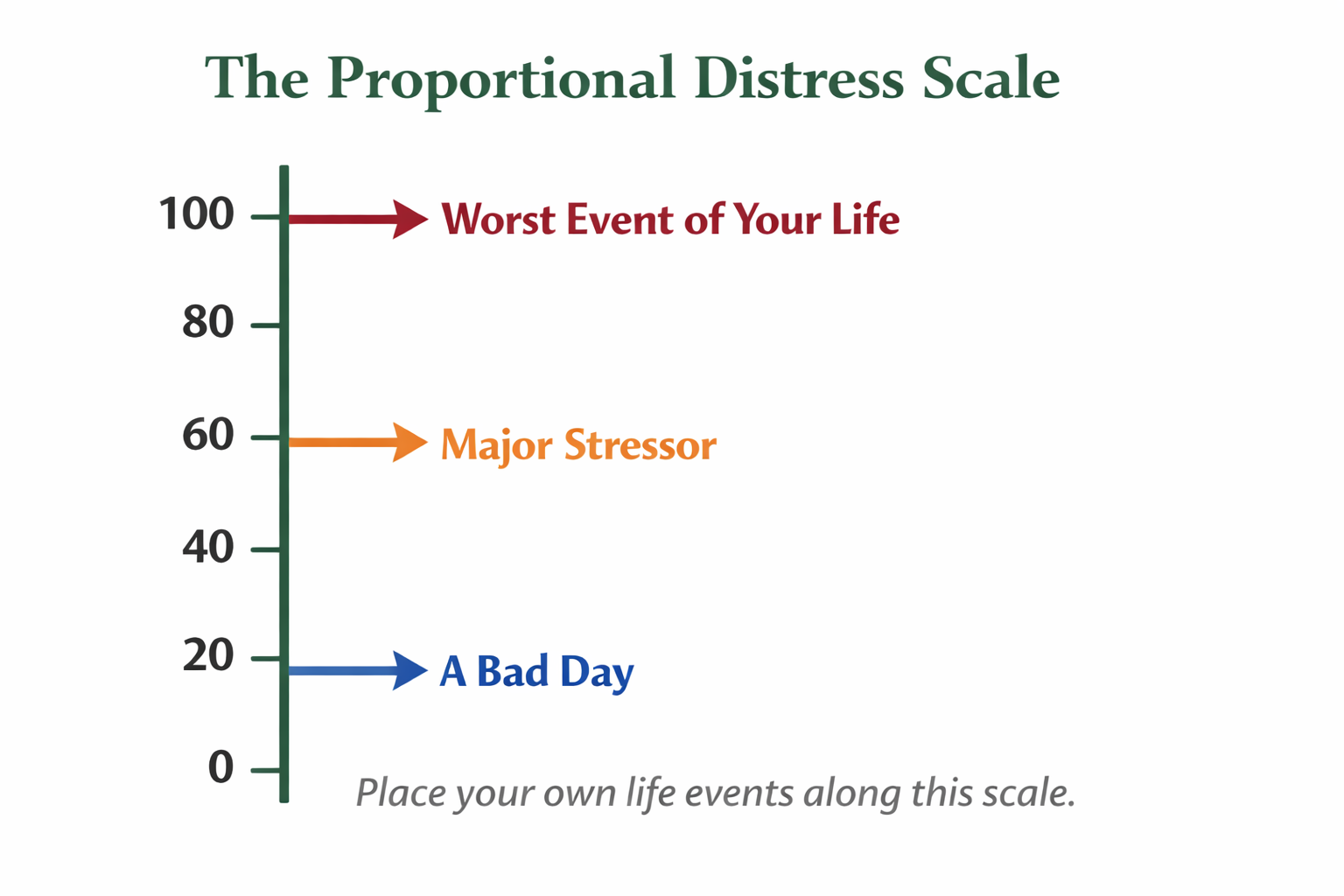
Anyone can use this.
100 is the worst event of your life. Not the worst thing you can imagine, but the worst event of your life. My 100 is the death of my grandmother when I was 19. I’ve met many people whose 100 is worse than mine. Everyone is different. We don’t compare traumas. If someone isn’t comfortable telling me or writing down their 100, I tell them to put down their 90 or 80. Then I ask them to figure out what a 60, 40 and 20 would be.
My 4Runner was stolen in Montreal in August of 2024 while I was on vacation with four friends. I had a lot of hiking gear in it as well. I was unhappy about it, but compared to my 100 and 90 and 80, it was about a 25. My friends asked what I was going to do. “We go on with our trip. We’ll go biking and then take a boat ride and get a great dinner. Just as planned. What else is there to do? Freak out? Ruin everyone else’s time?”
When I’ve taught it to my students or clients, I start off with the story of Chicken Little. It’s an old folk tale. The townspeople knew that the sky wasn’t falling; they all looked upon Chicken Little with great annoyance. There is a valuable lesson about human nature there: people don’t like being around people who catastrophize. It’s exhausting.
A student asked, “What if you have a client who says everything is 100?”
“Great question. For Chicken Little, everything was a 100. He had no perspective. Everything was a disaster. He ends up alone. This scale is most specifically for the people who rate every problem, every aggravation as 100. We use this to teach them perspective.”
Last week, a student asked me, “What if you haven’t been through much? That nothing bad had really happened in your life?”
“Well, good for you. Try to keep that up as long as possible. Don’t apologize for it though. Whatever your worst moment is,” I told him, “that is your 100. At some point, it will almost certainly be replaced.”
I have sat with many people during the worst moment of their lives. I always tell them that they are supposed to feel awful. Usually powerless, usually scared. There is no quick way out of it. For some of the worst moments, I tell them that they have the right to collapse, though I don’t recommend it. Instead, I recommend therapy, sleep, exercise, healthy eating, time with family and friends, enjoyable activities and just moving forward. Even if you don’t feel like it.
Sometimes, something that feels like a 75 today is a 30 a year later. “It wasn’t that big a deal,” or “I didn’t think I’d ever recover” and sometimes even “I learned a lot from that” are phrases I hear from clients.
When I look back on my grandmother’s death (100) or my friend Eric’s death (85) or my Dad’s (80), I can remember how terrible I felt. The sadness. The fatigue. The utter loss. But, I don’t feel that way now. They still are a 100, 85 and 80, but they don’t cause me serious distress. I don’t feel the way I felt when those events happened.
If someone keeps experiencing a 100 or a 90, months or years later, that is PTSD. You still feel like you are in the moment, experiencing the pain, long after the event has passed.
I sent this article to my niece, who is almost 18 now. “I remember the lesson but I have almost no memory of the cow losing its eye. Which shows it really was a four on the scale and not important at all.”